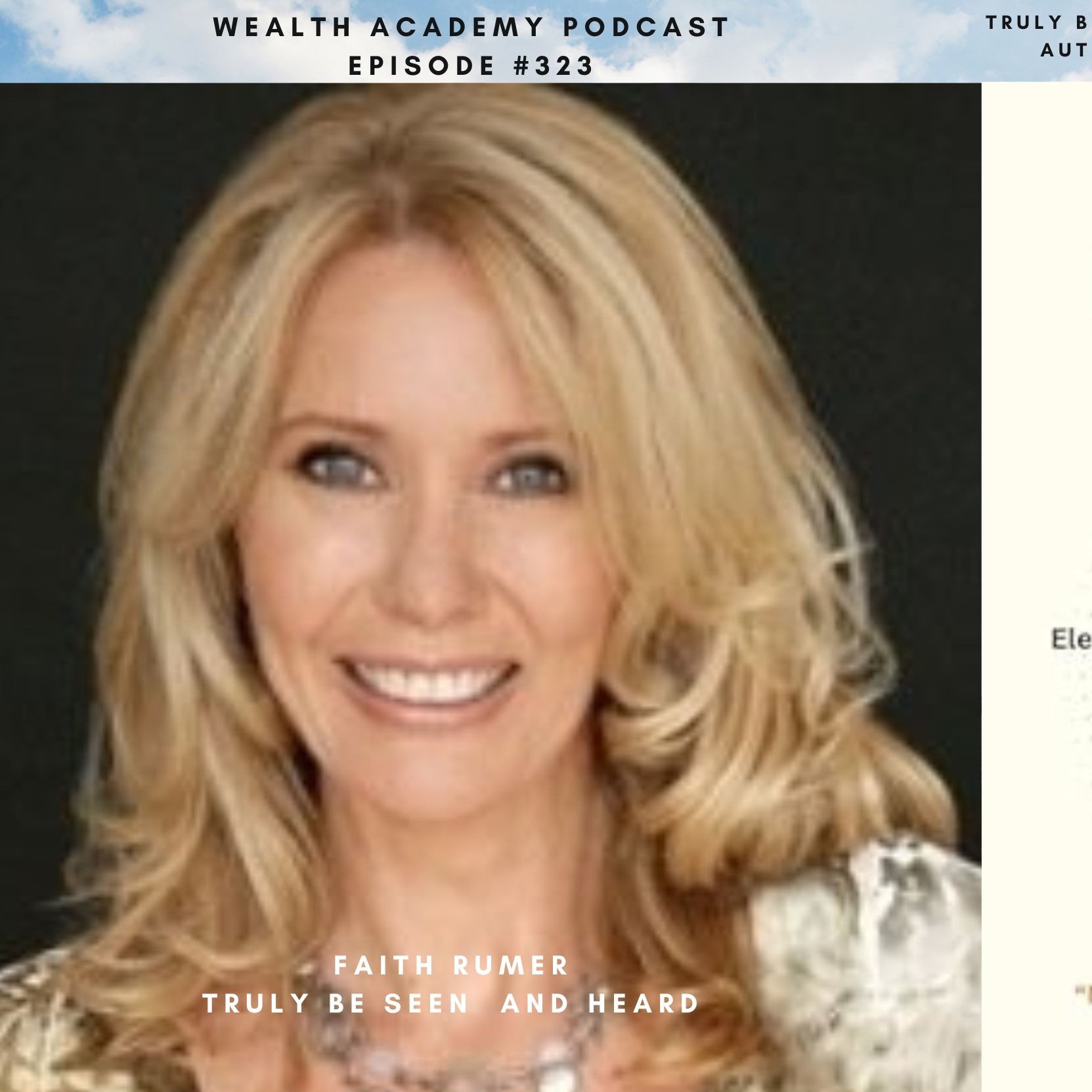
Episode 323 - Truly Be Seen and Heard, Unlocking Your Authentic Voice with Faith Rumer
The Story
In this powerful episode, host Paul Lawrence Vann welcomes Faith Rumer, performance empowerment coach, voice and speech consultant, singer-songwriter, actor, and author of Truly Be Seen and Heard.
Faith shares her journey from performer to globally sought-after voice coach and reveals how your voice is the key to authentic communication, leadership, and confidence.
Listeners will learn how to access their true voice, connect from the heart, and use presence to influence and inspire.
Key Topics Covered
- Faith’s personal journey to becoming a performance empowerment coach
- The connection between voice, mindset, and confidence
- How to move from invisible to visible in your personal and professional life
- Vocal and breathing techniques that unlock authentic expression
- What it means to “raise your impact” through presence
- Insights from her new book Truly Be Seen and Heard
- Why your voice is your most powerful leadership tool
- How to overcome fear and self-doubt when communicating
Email: [email protected]
Phone: 310 948-4335
Voice, Presentation & Performance Coach
https://raisingyourimpact.com/
Speaker
Voice, Singing, Acting & Dialect Coach
Speaker 1: Welcome to Wealth the Academy podcast. Thanks for tuning in to listen to this dynamic and insightful podcast with host Paul Lawrence Van. Paul and his guests provide content rich information that will enhance your knowledge. Enjoy this episode.
Speaker 2: Good day, good day, everyone. This is your host Paul Lawrence Van. I hope that you all had a wonderful day. And this particular episode features an extraordinary, extraordinary guest, her name is Faith Roomer. Faith, how are you doing today?
Speaker 3: Well, it's raining here very hard in Los Angeles, but so I have weather, but I don't know.
Speaker 2: Fantastic. We have rain as well here in Maryland, New Washington, D.C. So we've been in that E.S. West Exchange here. So welcome everyone. Of course you know, well for Academy of Podcasts, all about getting these amazing guests like Faith and she's going to share some important things for you to understand and of course throughout this interview, it will give you a chance to really look at who you are through this conversation. So welcome to the well for Academy of Podcasts where we believe wealth is It's about influence, impact, and how you show up in the world.
Speaker 2: Today I'm joined by an extraordinary guest as I've mentioned, Faith Roomer. She's a performance, empowerment coach, voice, and speech consultant, singer, signwriter, and author of truly be seen and heard. Faith's, Faith has spent decades helping actors, artists, entrepreneurs, and leaders evaluate their presence. project confidence and speak with authenticity. If you've ever felt invisible, unheard or unsure how to communicate your truth with power, this conversation will help you find your voice and use it to lead.
Speaker 2: So we're going to get right into these questions now and so fast in your seat belt everyone because faith is going to deliver just another masterpiece that's So what inspired you to dedicate your life to helping others find their authentic voice?
Speaker 3: Well, I would say, honestly, it goes back to when I was a little girl. I always felt this pull towards expression, towards using my voice, but really also helping others. I remember as a kid, always trying to teach and coach other people how to do things. But as a child, not ask for too much. I was taught that it was not nice to show off. In fact, every member of a moment where I was in had a new pink dress on and I went, Ta-da, and my mom said, honey, it's not nice to show off.
Speaker 3: It was like, oh my gosh, so I learned that kind of to hide my light and shut down my creative energy, but I still wanted to express myself. So eventually I found my, you know, expression in music and then the arts and even and drawing in the world of music and acting. And then over the years, as a performer and as a vocalist and a coach, I kept seeing the same thing that people with a repeat was so much talent, so much heart, but they were in hiding. Sure. They didn't trust their own voice.
Speaker 2: Could they have been introverts, perhaps?
Speaker 3: Well, and that's one way, but you know, sometimes we maybe are not entered. We, I always thought of myself as an introvert, even though I've sung in front of 50,000 people.
Speaker 2: Me too.
Speaker 3: Yeah. Yeah. But I've always felt that way, and it's because I was not encouraged to like shine my light to go, hello, hello, how are you? Now, that's changed a lot for me.
Speaker 2: Fantastic.
Speaker 3: You know, I'll walk into a room and I'll just talk to people. I go to, you know, the store and I'll just chat somebody up because I feel like that we, we all have a connection and people are interesting to me.
Speaker 2: Yeah, same with me, same with me. Now are you from a large family by chance as far as siblings?
Speaker 3: We four kids, four group us kids. So yeah, it was a lot. My, you know, my parents had a lot to do and my mom had a lot on her hands. and that we were all kind of born at the round the same time, so it was a lot of small kids, so she needed us to behave.
Speaker 2: Absolutely. Now, do you have a sister or all brothers?
Speaker 3: I have two sisters and one older brother.
Speaker 2: I think they're fantastic.
Speaker 3: Yeah, yeah.
Speaker 2: It was an introvert faith as well, and I'm one of 10 children.
Speaker 4: That's fantastic.
Speaker 2: Five sisters, four brothers. And my older sister and I had to kind of raise them as we were in our pre-teens and teens. So I understand, and my voice, I was told to don't say anything in front of adults, the same way, yeah. And I'm not sure why, but that's just the way it was in our generation, I suppose.
Speaker 3: I think that's part of it, you know, and I, and also it's a lot for a parent, when you have a lot of children, it's a lot for a parent to handle all of the noise, all of the energy trying to calm it down all of the time. And so we're not encouraged to get out there, you know, and my book truly be seen and heard is about how it feels almost like an epidemic now where people are feeling unseen and unheard. Yes, I believe that being seen and heard is a basic human need, the need to think about little kids how often they'll go, you know, look at me like I mean they're doing something they're doing some kind of sport or at the pool they're going to do a summer salt and they want their parents to watch them or their siblings.
Speaker 2: Exactly. And that's it's innocence as well. Yes, that's speaking from that love and joy inside there. They're spirit.
Speaker 4: Right.
Speaker 2: And so that's part of that right there. And of course, we know today with technology being what it is children a lot different in terms of their orientation growing up is more with the device more so than human to human. You should.
Speaker 3: Yeah, and you know, that's as is to create our businesses successfully to have those kinds of successful, not just businesses, but life in general, we need to communicate. We need to communicate what I call and we need to become not just good communicators, but awesome communicators.
Speaker 2: For sure, for sure, I totally agree. And it's happening each and every day.
Speaker 4: Yeah.
Speaker 2: They've how do you define being seen and heard in the world? That's constantly. I mean, constantly talking rather than listening. Yeah.
Speaker 3: Well, I think that to me, it's about being not about being loud. It's about being received.
Speaker 4: Yes.
Speaker 3: So even when I teach breathing, I teach just not, I reframe the whole idea of how we breathe. We don't take breath, we receive the breath.
Speaker 2: Ah, very nice.
Speaker 3: So you see if you're clients, you don't take them.
Speaker 2: Yes, I totally agree. Would you like to share any breathing techniques or anything?
Speaker 3: Well, that's a really simple one. So if you just imagine that you're opening your body, you're going to open your body completely. And then we're going to receive the breath down through the nose, mouth through the throat, everything. And then fill up the bottom part of your lungs, just fill up the bottom part of the water. Okay. And just hold that. Yeah. Let it go. Now I saw a little bit of taking Paul because he had We're more in the taking place of it, and that's often the way we're taught in yoga and so many places, but if we just go, open there you go, and let it go.
Speaker 2: Yeah, mine was, and you're exactly right, faith, because mine was coming from a position of having played competitive sports, football, and track. And so we tend to take those larger breaths as you state it. And so you picked up on it just like that.
Speaker 3: Right, and we can receive just as large a breath, in fact, is actually more because we'll take the breath we're tightening up here a little bit.
Speaker 2: And we're only filling up this part of our lungs like if you could see me from here up and we want to get the bottom part of fantastic fantastic and I know people who are listening those who are listening to archive of course they can also practice this as well with faith is just shared with us because it really has a lot to do with our energy as well, our spirit. Absolutely. Absolutely.
Speaker 3: Most people speak from their surface cells, the rushing, the performing, the trying to get it right.
Speaker 4: Yes.
Speaker 3: But when you're grounded and authentic and present, people feel you.
Speaker 4: Yes.
Speaker 3: And it was wonderfully. So that breath just helps us to drop down into that present moment.
Speaker 2: Yes, and it also helps us to also resonate with others.
Speaker 3: Yeah, that's the energy level that's been a transmitted and how often do we are speaking with somebody and we're not really listening to the other person. We're waiting for our moment to speak or thinking about what we're going to say when they're finished.
Speaker 2: Yes, it's a difference between being hurt and listening.
Speaker 3: Yes.
Speaker 2: In other words, we may hear something that go from one ear to the outside of the other, it's the quote goes. But when we actually listen, that's where the real communication takes place.
Speaker 3: And then it's in that communication. Our voice has the capability of motivating people, of inspiring people, educating, closing deals. Yes. And even changing people's lives. But it's really about how we show up. because our voice isn't just about speaking, it's about how we show up.
Speaker 2: Absolutely, and I all given an example that I was the elected, the PTA Parent Teacher Association president of my children's school for two years, and it wasn't a election. And so there was an aspect of, I really had to listen not only to the students, but the teachers to principal and the parents. And so you have to be a really great leader and really listen to people because people in the audience they want to be heard.
Speaker 3: Absolutely. They do.
Speaker 2: They want to be heard. So that's fantastic. You work with Oscar and Grammy winners. What's one universal challenge even top performers face with their voice? It's going to be interesting.
Speaker 3: I will say that even the best performers face fear. fear of being judged, of not measuring up, fear of not being enough. And people assume that confidence is just automatic that it's at that level, but it's not, especially when they're facing and doing something new. So I worked with a Grammy winning, well, Eddie, Eddie Van Halen, you know. Yeah. Yes. rock guitar, the most confident person on playing guitar, you could ever imagine.
Speaker 4: Absolutely.
Speaker 3: But he wanted to give me come a better singer because he wasn't sure if he wanted to do an acoustic album or what he wanted to do. So he hired me to work with him and and he, of course, of course, was in that confident. that he could do we wanted to do, but he was willing to try. And that's what I've realized in the top performers, is that even though they face the fear they're willing to try.
Speaker 2: Absolutely. And Ediglan Hayland is one of the best ever.
Speaker 3: Yeah. I learned something about, you know, asking for what I was worth, you know, when I was working with him as well.
Speaker 3: The funny stories that I get a call from Eddie Van Halen and my office, and I answer the phone and the person says, hi, it's Eddie Van Halen, I went.
Speaker 2: Somebody's trying to prank me. Stop it, stop it now. That's really. Oh, yeah.
Speaker 3: And then he hired me on our first time meeting. I went to up to his studio. And he said, well, what do you charge? She didn't ask me on the phone. And I told him, and he looked at me. And he goes, I don't think that's enough.
Speaker 2: I like Eddie.
Speaker 3: I want to pay you this much. Because I think you're worth it. You have to drive here. And I learned that I was undervaluing myself.
Speaker 2: So he had that awareness to understand. He probably had check with some other folks as well, some other experts.
Speaker 3: Yeah. And you know, what an interesting, he probably did the same thing to himself, where he ended himself until he got to the place we're now. He could, you know, all the shots. Right, exactly. But that's a really great lesson for all of us.
Speaker 2: But sure, don't under the how you Now, that really, the first thing when you said that, I thought about Barbara Streisand. But she also had trouble when it came to singing in front of audiences. She was very shy and just they had to really calm her to get it on the stage to perform to that whatever it happened to be, which I was really shocked about that, because her performance is just knock and socks off, just like Ed event Hayland, knock and socks off.
Speaker 3: Well, what I know about that is that when she was younger, She had a lot of moxie. What's we would call that and she was 19 years old. She was on Broadway and she was literally performing. It was later on in her career where she hadn't been performing that much. And then they wanted her to come out and do a tour and she could do it. Partly because the expectations about what her voice needed to sound like were so high. So when she's first starting out, she's making her way, you know, people will work like, whoa, this new, who's this new person?
Speaker 3: This is wonderful. Now, it's Barbara Strasson. You got to hit that note.
Speaker 2: Absolutely. Exactly. Exactly.
Speaker 3: Yeah, Michael Jordan, you know, what they expected for Michael Jordan.
Speaker 2: Oh, yeah, the best stand, the stand is fine.
Speaker 3: I know, I'm a big, I was a big Michael Jordan fan being from Chicago.
Speaker 2: Absolutely.
Speaker 3: I remember watching him once in a playoff and he, one night, he could not miss anything.
Speaker 2: Everyone, and he, what? That's when he held his hands up. Yeah, you saw that when he got caught, then try our blazes.
Speaker 3: I don't know, right? You know, that exact same thing. Tonight, he had he only made 20 points, which for Michael Jordan was not enough.
Speaker 2: exact. That was warming up.
Speaker 3: Yeah.
Speaker 2: Yeah. See, I knew Michael Jordan of him through the fact that I'm from the state of North Carolina. He played for USC chapter. He up. That was my favorite to hear.
Speaker 3: That's right. That makes sense. Yeah.
Speaker 2: So that's fantastic. And they're just a lot of music artists, actors, actresses that have that challenge of really getting in front of that audience and performing. And some would actually get sick before they perform. That's how much the pressure that they've applied to themselves, and I think that's healthy because that means they want to do great.
Speaker 3: Wow, you can look at it, can we shift that energy of your fear, anxiety into enthusiasm and excitement.
Speaker 2: Absolutely, absolutely. And that's what we want people to take away from this.
Speaker 3: So yeah, that's great. You know, and what happens when we as far as what affects the voice, when we get anxious or worried or fearful, we tense up, and then we can speak very well.
Speaker 2: Yes, I want to share some with you faith that it's going to be kind of funny though, but when I was younger a teen, you know, going through that period in high middle school high school and I was when I get around a young lady that I like and I really just I would perspire. I was so nervous and I didn't really know what to say so my words kind of came out jumbled but it was innocence yes yes yes it was innocent and that's what this discussion has reminded me of that and like oh my god what was that thinking I should have said nothing
Speaker 3: Yeah, maybe I know, but you know, it's like even allowing or the more we practice something, the easier it gets. So maybe if you asked 10 girls out, it would got, my, you know, I need more repetition.
Speaker 2: Yeah, they just say, we just a player is that and then he wasn't Michael Jordan either.
Speaker 2: life is beautiful. So when it comes to this particular question, how does voice reflect our internal state, our emotions, beliefs, and minds that, and I'll just flow it down a little bit here, but how does the voice reflect our internal state?
Speaker 3: Yeah, well, there's a vital connection between And also those minds that that we are just talking about when we don't think our voice matters. We don't tell people how we truly feel or how we think. We don't share our dreams, we don't speak up, we're not showing up as who we are. Sure. And then when we suppress our voice and our emotions, we suppress our presence.
Speaker 4: Yes.
Speaker 3: That affects our body, our behavior and the way we show up in the world.
Speaker 2: Yes, absolutely, absolutely. And when it comes to our emotions, how does the voice reflect our emotions?
Speaker 3: Well, the voice is the, I sometimes called it the window to the soul.
Speaker 4: Yes.
Speaker 3: So whatever your feeling is going to be reflected in your voice, you know that sometimes, you know, somewhere you'll say to someone, how you do it and they go, I'm okay. Now there's saying words, I'm okay. There are research that shows that our impact that we make on people, that 7% is about the words. 38% is our voice and the tone of our voice and how we are delivering the words. And then 55% is about our body language.
Speaker 2: Yes. Yeah, so that's all the communications that people that's taking place with people.
Speaker 3: Yeah, yeah, yeah, yeah, yeah, I've always doesn't lie, we don't our brain has developed in such a way. I was doing some research on this today. I was looking at a book that was talking about this in our brain was developed in such a way that we could discern to keep ourselves safe, another being going, you know, ah, what, what that meant. And there's our limbic system, our part of our brain will react to these things that are encoded into our brain. So if you hit your thumb with a hammer, you're automatically make a sound.
Speaker 2: Absolutely. Whether we want to or not.
Speaker 3: Yeah. And actually it was up in our lives. You saw I going, oh, something like that or.
Speaker 4: Sure.
Speaker 3: Oh, really? Now, I, you know, I am a firm believer of voicing our feelings. Find a way to speak your feelings out loud, even if it's a couple of minutes by yourself, voicing with your feeling.
Speaker 2: Yes. Yes. I know there's this thing about speakers. I'm a speaker as well. I know that you are also that that's what people come in. The scariest thing for people is public speaking. I believe the way it goes.
Speaker 4: Yeah.
Speaker 2: And I guess a lot of it is self-belief. Yeah, part of it's self-believing in oneself. Not wanting to make mistakes. That's the worst thing that can happen. It's okay to make mistakes if you're speaking. You didn't want to. No one in the audience knows.
Speaker 3: What even if they do? And you said, and I go, I'm a go back and talk about this. And they would, oh, sure, they'll go right along with you. Sure.
Speaker 2: Yeah, it's like one of my speaking coaches said the late daddy Walters. She wrote the book, Speak and Grow Rich. I went out to Burbank, California, and a marketing symposium she held. I sit beside Lufra Rigno, the incredible hall. He was in my class. I can say that. And there was this aspect of she said you really have to refine your voice you have to really work on it all the time it's not something you can just some people can go on stage and say anything but that those are the celebrities to athletes etc but for the average person you really have to hit the mark.
Speaker 3: Well, even the athletes in the Celebrities work on their voice, one of my clients is Akbar Basjabi Amila.
Speaker 2: Yes.
Speaker 3: Do you know who he is?
Speaker 2: Yes. Hey, he's one of the announcers for the show. The competitive show.
Speaker 3: We're a very high-end of warrior.
Speaker 2: Warion, isn't that, believe me? Yes.
Speaker 3: And he's been on that show. And when he first started at that show, we started working together. And he just had retired from the NFL. Yeah, and Raiders and I think San Diego. And so he was starting. He wanted to be a sports castor, like it was a cult commentary. And so I was working with him on his voice. And then he got the opportunity to be the co-hosts for American Ninja Warrior. That's going to require much more expressive, bigger, sounding voice than he had.
Speaker 2: Sure.
Speaker 3: So we work on that.
Speaker 2: That is wonderful. That's that is so amazing. And when you get down to it, look at what's happening. Ninja Warrior is now part of the Olympics.
Speaker 3: he's amazing. And then he also was the became the co-host for the morning show, the talk. So he was on that of CBS. So that's such an interesting thing. We learned a whole different experience too. But he got so beautiful, speaking, and using his voice.
Speaker 2: Yeah, that is a made special for NFL player. athlete, my cousin played for the New York Giants, got drafted by the New York Giants. And so I got a chance to meet all of the Giants when I was in college. And so that's that platform. And then for him to transition and he's doing the Ninja Warrior, that is really a transformation. So let's also look at the forcehouse reflected in mindset.
Speaker 3: Oh, sure. Okay. So, see, I'm sure that it kind of goes along with our idea of the emotional, it's very hard to not have those connect to each other. In my book, I talk about something I call the non-verbal communication loop trigger. I didn't know, that is mine, right there, nonverbal communication with the trigger. So we have these nonverbal things that happen, you know, this is simply climping in our body, our body language does something we have a panic attack, right? So what starts it, the idea, a situation happens, I have to give a presentation.
Speaker 3: It's got to be perfect, or I'm going to be fired, or I won't get, you know, or someone's not going to be able to. Right. So that thoughts start to create some chemicals on our brain, which then gets released into our body, and we experience that as emotion. Now that is just energy. So energy of anxiety. So then the body reacts and sweating. Right, I know about that, but not being able to take your breath. I was working with a financial advisor and that's what he was going through.
Speaker 4: She was.
Speaker 3: He had that sort of panic attack when he had to present in front of his bosses. So we had to work with calming that body down using the breath, using the voice.
Speaker 2: And one question I want to ask you now, it just came to mind when you're receiving a call from Edith and Helen and others. How do you feel when you receive a call like that or from others that you work with? And what do you say to yourself when they call you and contact you to work with them? What is that light?
Speaker 3: Well, first of all, it's exciting on some level, obviously. And you know, when you get to that place where someone's going to call you for that, you're in a place where you know what you're doing, right? So you have to, for me, I'm like, I know what I'm doing. I'm here to serve them. He's an interesting thing. Yeah, so there's that. called in at Paramount Pictures to, by Peter Bogdano that's at the time of the winter. And he wanted me to work with an actress on a movie. They were shooting, but I was going to go to New York and work where they're there.
Speaker 3: So I give there, you know, and they say, can you be there? And I go, I always say yes. You say yes.
Speaker 4: Oh, yeah.
Speaker 3: I'll say it. And then figure it out. Does that, you know what I mean? Yes, yes, yes, yes, yes, yes. So I get to the, I get to his office and then I get into his office. He says, I have 10 minutes before I have to get on a plane. Sure. Why should I hire you?
Speaker 2: Oh, interesting question.
Speaker 3: Yes. So I said, because here's the thing, I need to know what he needed. her to do, because then I could say if I could help her more not. Because I know what I can do, I know what I can't do too. You know, so I said, well, what do you need her to do? And then he started to tell me what he was she needed to do. And I said, I can help you with that.
Speaker 2: Fantastic, fantastic. I know you inside, you're just bubbling and that's a great thing. Things that are taking place and you get energized because now you know that you can make a difference or this particular individual for this particular purpose.
Speaker 3: And, you know, it goes back to being prepared, you know, when you're prepared like when you go out in the speak, if you're not prepared to speak, you know, you will show absolutely supporting in the reps, whatever it is that we need to do is a super important thing.
Speaker 2: Absolutely. Now, you also the founder of raising your impact, let's talk about that just a bit.
Speaker 3: Well, that's my business where I work with speakers and entrepreneurs and CEOs of billion dollar companies. And you know what you've said about everybody being the same. It's the doesn't matter. I'm sure you know that people with, yeah, we're all operating from that same human level. So that business is a form for that to work with as a life coach, as an inventor. You know, six month programs, yearlong programs with them, helping them to really live their most express life.
Speaker 2: Oh, wonderful. Wonderful. I put it like this, faith, rumor. You are a gift.
Speaker 3: Oh.
Speaker 2: Blessed gift to people. At first, to yourself, and then to the people that you serve.
Speaker 3: Yeah.
Speaker 2: Absolutely. Absolutely. Now, let me share a little bit more about faith. She's, um, with, she has a master's in speech pathology, focus on voice science and career coaching for Oscar and Grammy winning performance, TV hosts, founders and podcast, the mouthful.
Speaker 2: And she was the former musical director and co-facilitator for a Gapai International Spiritual Center. They're in Los Angeles. Yeah. Yeah. All I know is I'm in the presence of royal tea. Oh, my God, thank you.
Speaker 3: You know, I just get, I show up and, you know, I have a, want to do my accent, the best I can do. I have a bar of excellence, not perfection, you know?
Speaker 2: Yes, I can assist you. [UNKNOWN]: Yeah. Yes, consistently. Well, we wanted to have you here for sure. So could you share a practice or exercise that's helped people unlock their natural voice and presence?
Speaker 3: Could I share, yes, okay. So this is an interesting thing. We can unlock your voice in many different ways. The breathing was the first step. But the second step is about your energy. What kind of, or how do you want to feel? And so what we can do is if you just, maybe you want to feel, I want to feel inspired, I want to feel, I want to bring that feeling of being bold or that, that could be something that you want to bring into the moment. What about being curious?
Speaker 4: Yes.
Speaker 3: Right. So it's more on and reflect what it felt like to be curious as a child. Yes. Like just feel it in your body. Let your body feel that curiosity.
Speaker 4: Yes.
Speaker 3: Oh, like that about. That looks interesting.
Speaker 4: Yeah.
Speaker 3: And we could take that energy into our meeting, into a conversation, even a tough conversation. Bring that curiosity into a tough conversation.
Speaker 2: for sure, for sure.
Speaker 3: Or whatever it is that we want to practice, and I call practicing these energies in our body.
Speaker 2: Absolutely.
Speaker 3: And that's the breath, what energy do you want to bring? And then how do you want other people to feel around you?
Speaker 2: Yes. And that's just like asking the producer, what do you want, what do you want the actress to do? Yeah.
Speaker 3: right.
Speaker 4: Yeah.
Speaker 2: That's fantastic. Just inside I'm just bubbling because I'm like, you know, that's really amazing. That's amazing. That's what I say.
Speaker 3: Thank you. It's a really wonderful easy practice that we can use to really shift our, you know, our energy. And you can always learn vocal skills, you know, of how to breathe, how to express yourself. Those are things I teach, Those these basic things are so easy to implement right away, right?
Speaker 2: Just bring it from the internal and bring it out for sure, for sure. Now, you recently performed and were a participant at UCLA.
Speaker 3: Uh-huh.
Speaker 2: University of California, L.A. When I had my first Air Force assignment, I was scheduled to go to L.A. Air Station. And somehow, one of my friends in an assignment, I ended up in Dayton, Ohio. And I had planned on getting my master's at UCLA, but it never happened because I was in Ohio with their time to share a bit about your recent and this was last weekend. There at UCLA, what was that like, and I know there was some guest on there, a lot of people are going to be aware of.
Speaker 3: Well, it was a I was filming my talks there at UCLA and we had some wonderful other speakers that I shared the stage with. It was an incredible energy I spoke about the how to speak up and show up and shine in our lives and then I also spoke about how to really engage and communicate with others, how to become an awesome communicator. So I had a few different things I was talking about, but they worked together and it was an amazing experience that little exercise I just shared with you was one of the exercises I shared with them.
Speaker 2: That is amazing. That's really amazing. And I know they really appreciate it as well. Yes, I know they appreciated that.
Speaker 4: Yeah.
Speaker 2: I had a family member on the mom side of the family and her name is Marie Cole. She was the wife of that King Cole.
Speaker 3: Oh my goodness.
Speaker 2: And so when I just came out to work in Los Angeles, I did a lot of work in Northridge. I would stop And I would stay over. We would just have a great time. And of course, you said LA was one of my favorite. That was the school I was supposed to get in my master's at.
Speaker 3: Wow, it's a great spot. I'll live very far from it. So it's here.
Speaker 2: Yeah, yeah. And of course, if a neck can't go, he lived out in Brinkwood, but California, for sure. So one is focal authenticity, essential for leaders,
Speaker 3: Well, that, the key to becoming an awesome communicator. Um, I have actually a formula for it, is we need to develop our power and presence, which we've kind of been talking about, but we all, that's not really enough. We need to add genuine connection.
Speaker 4: Yes. Um, important.
Speaker 3: Yeah. Power and presence you're going to work on your voice, your the way you carry yourself, your commanding a room, you're going to work on being able to, you want to be seen and heard all of these, you ask for what you want, all of those things are your power and presence. But your genuine connection is about really having empathy, support, motion intelligence, motion intelligence, that you're willing to show up for other people, that you have good effective listening skills. All of those are super important for genuine connection.
Speaker 3: When you put the two together, now we have two confidence.
Speaker 2: That's you, right?
Speaker 3: We have, we can inspire people real and we're good leaders at that point.
Speaker 2: absolutely, absolutely. I tell you that this is so important and I really want especially younger people to really understand this because I have two generalizations, these children, and their communications is totally different than mine in my generation. In fact, a lot of times, they really don't want to talk.
Speaker 3: Well, they're on their devices, you know, so much. And that can really make a huge difference. I remember, and this is kind of a funny thing, going to a party, so it actually was a bar mitzvah. So they're talking, they're talking, they're talking. And at the table, all of the kids, all dressed up in their party were all in their phones. Every single one of them. Nobody's talking to anybody. [UNKNOWN]: Yeah.
Speaker 2: are I've seen couples on a date and they're both their devices and like what?
Speaker 2: Yeah, that's a lot different and that's what I see with my children and I just told them said another form of communication of course as a part of a voice is writing. And I said, I can remember when, of course, there were no cell phones when I was going up, you had to pay phone with a quarter. So I happened to see one and I took them over and then they said, what is this? I said, what the whole is back in the day? It's like back to the future or something, right? Right. Right. And then I said, well, I used to write my aunt and uncle in New York letters.
Speaker 2: And so it's a challenge for them to write an aspect. and so it's a lot different so I think for our young but what would you encourage our young folks to do to help with their communication, their voice?
Speaker 3: Oh, that's a great question. Why I gotta tell you, I used to teach a teen acting class.
Speaker 2: Oh great.
Speaker 3: And I said no cell phones, I said, you can, is that if you get a call and it is a, um, important call. Or you go out in the hallway, you know, uh, to get it, but otherwise we know, not even text nothing. Nothing. So I didn't want to able to. And, um, they were a little scared at first, like, what do you mean? So I think that, The first thing would be to put down the phone and just talk, just talk to your friend. I would say, ask them what's going on with them, how they feel, what's happening in their life.
Speaker 3: Get interested in somebody else, I think that would be one of my suggestions.
Speaker 2: I totally agree. I totally agree. I told my children. I said, just remember there's a thing called an inheritance.
Speaker 2: Come on to your father.
Speaker 3: I love it.
Speaker 2: I love it. Dad, what are you talking about? I was communicating with them. I was getting them to talk. Actually, that's what's happening. So, yeah, that's a little different time and space now, faith, different space. So let's talk a little bit about your book. That's about it. Your upcoming book is truly be seen and heard. What do you want readers to walk away with as a full plane for your book?
Speaker 3: Well, the book is out on Amazon. It's now a best seller so you can get it up on it. Congratulations. It's very much. Thank you. I'm really exciting. It's my first book. And I would encourage anyone who has a book inside of them to write it.
Speaker 4: Yes.
Speaker 3: Yes. Yes. So the book is really a guide into stepping into your full presence. Your voice, your emotional truth and your authentic expression. find your authentic voice and go from invisible to visible.
Speaker 4: Yes, not so.
Speaker 3: So yeah, it's really what I, you know, for me, I wrote it as a more of a transformative journey for someone than just to learn about how to speak so that they can be seen and heard in every aspect of their life. I want them to go away knowing that in here, I say that everyone deserves to feel authentic and powerful.
Speaker 2: Absolutely.
Speaker 3: Everyone deserves to speak up for their needs and their dreams, right? So my goal and writing it was to empower people with the skills that they could to create the impact that they could get their gifts and talents and their thoughts and ideas out into the world. And if I were to say, you don't have to change who you are to be powerful, So you have power more of who you are.
Speaker 2: Well, yes, yes. Because I know I had a post other day. I was kind of sharing about it. Conversely, so I was having with a cousin, I said, he didn't have a problem with what I was saying because it's all my experience in my truth. Yeah. That's not a problem with me being the one saying it. There's a big difference. and I told people never allow anyone to silence you because it was an aspect of trying to silence someone. I'm too old to be silenced.
Speaker 2: I tell people I said, let your voice be heard, be your authentic self and continue being who you were created in purpose today.
Speaker 3: And as we explore our body and our energy and our voice and we allow ourselves to speak up and find our authentic voice, we actually discover that we have all these hidden gifts and talents that we never thought we had.
Speaker 2: definitely, definitely. And something that you mentioned earlier about being curious to me, that's one of the most important aspects of having that authenticity there. Yeah. If you a person thinks because there are aes that they can't learn something new, but you can learn something new to the last breath that one takes.
Speaker 3: that's very true. That's very true. It's not over till it's over, right?
Speaker 2: Literally, I totally agree. I totally agree. So faith, how can people continue to grow in their confidence and impact after today's conversation? What do you want people to take away from your conversation today?
Speaker 3: Well, I kind of said that. Start small. Practice using your voice every day, not just to speak, Like, like, what's going on with you today, you know, how do you feel? Or, you know, is there something you need? It's just connect with them. That's right. Yeah, it really is. Surround yourself with people and mentors or communities who lift your voice up rather than quiet it. Yes. Right. And remember that you'll be afraid. It's a natural part of expanding into your personal greatness. and all you have to do is take one step at a time and you'll get there and you don't need to compare yourself to anyone because the world needs your unique gifts.
Speaker 2: Definitely.
Speaker 3: Definitely. And there is a way, even when it feels like you don't know what to do.
Speaker 2: I agree. Out of eight billion people, there's significance with the one individual.
Speaker 3: Yeah.
Speaker 2: Yes, absolutely. That was just amazing. That was amazing. And in faith, I'm really honored, you and I, of course, met with Blu-Tar. That's right. And it was a great, great experience for Corey. Corey, it's just amazing. It's not his name.
Speaker 3: Right, that's where I was at UCLA was.
Speaker 2: Yeah, and Heidi, yeah.
Speaker 3: Brian Heidi got a chance to meet them. They were just wonderful, wonderful people. You know, they walk the top. They speak their heart. They are there to serve and help everyone that which is a great model role model to help everyone that they work with.
Speaker 2: I totally agree. That's why I'm a part of it.
Speaker 2: Well, thank you so much for being our honored guest and I want to close here what a powerful enlightening conversation with Faith Roomer. She reminded us that our voice isn't just sound, it's energy, emotion, and our most human connection to others. When you speak from authenticity, you create impact. When you lead from presence, you inspire others to rise. Remember, your voice matters, just as Faith just reminded us. Faith, thank you for showing us how to be truly seen and heard.
Speaker 3: Thank you so much, Paul.
Speaker 2: Okay. And here's my call of action. I love to give people call to action, so that you can really engage and think even more about today's conversation with Faith. If you enjoy this episode, share it with someone who needs to find their voice. Follow Faith Rumor at raisingyourimpact.com. and get her upcoming book, book this here now on Amazon, truly be seen and heard. And don't forget to subscribe to Wealth Academy podcast where we help you to master self leadership mindset and money, so you can build Wealth Beyond Money.
Speaker 2: So faith, I had a fantastic time. I knew that I would, and I look forward to seeing more of you as your book, progressives, and make that cycle, especially this would make just a great Christmas gift. for family, friends, colleagues, and people that you know and love. So get out there to Amazon and get Faith Rumors book. And thank you so much. And then go out there to Apple Podcast, Raider Review this episode with Faith Rumors, provide her with a review and a five star rating. We really appreciate it.
Speaker 2: And again, I'm your host Paul Lawrence Van. Thank you so much for listening today at Faith Rumors. and recommend it to your friends, family, and colleagues, and we appreciate you so much, and I'll see you on the next episode of WellF Academy Podcast. Have a great day and happy holidays to you, babe.
Speaker 1: Thank you so much, YouTube.
Speaker 2: All right, we'll do. Have a great day, everyone, and thank you so much.
Speaker 1: Thank you for listening to this episode with Paul and his guest. I hope you enjoyed this episode, and Paul requests that you write and review this episode and others on Apple Podcasts. And wherever you listen to podcasts, view all wealth Academy podcast episodes at www.wealthacademypodcast.com.
 Apple Podcasts
 Castbox
 Castro
 Goodpods
 Moon FM
 Overcast
 Pocket Casts
 Podbean
 Podcast Addict
 Podcast Republic
 Spotify