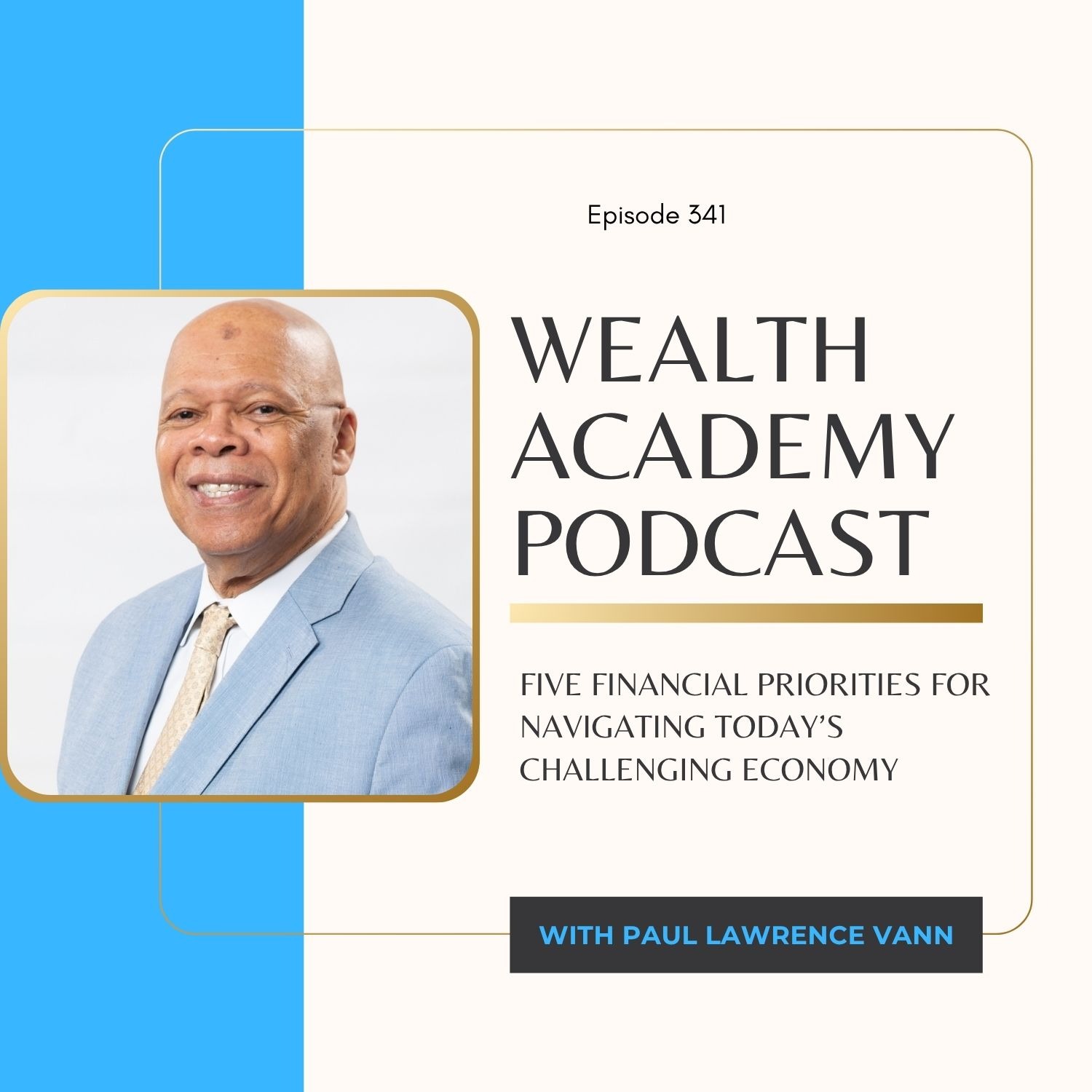
Episode 341 - Five Financial Priorities for Navigating Today's Challenging Economy
The Story
Welcome to Wealth Academy Podcast, where wealth is more than just money.
I’m your host, Paul Lawrence Vann, The Leadership Catalyst and today we’re discussing an issue that affects every household in America: how to navigate today’s challenging economy.
Food costs more. Energy prices remain unpredictable. Housing is expensive. Interest rates are placing pressure on borrowers, and many workers are concerned about the stability of their jobs.
The good news is that you do not have to control the entire economy to improve your personal economy.
You cannot control inflation, interest rates, government policies, or the stock market. However, you can control how you spend, save, borrow, earn, and prepare.
During today’s episode, I will share the five most important financial issues consumers should focus on during these challenging times:
Number one: controlling the rising cost of living.
Number two: building an emergency cash reserve.
Number three: reducing high-interest debt.
Number four: protecting and expanding your income.
And number five: making disciplined housing and investment decisions.
Let’s get started.
Speaker 1: Welcome to Wealth the Academy podcast. Thanks for tuning in to listen to this dynamic and insightful podcast with host Paul Lawrence Van. Paul and his guests provide content rich information that will enhance your knowledge. Enjoy this episode.
Speaker 2: Good day! Welcome to another exciting episode of Wealth the Academy podcast. Where Wealth is more than just money. I'm your host Paul Lawrence Van. This particular episode, which happens to be episode number 341, we're gonna delve into the five financial priorities for navigating today's challenging economy. And we know, through reality, that this particular economy is pretty tough, and let's hope we don't end up with another recession here this year, about a year in. So today, what I'll be talking about
Speaker 2: terms of the priorities for navigating today's economy here in 2026. So welcome to wealth category, podcast. And as I stated before, wealth is more than just money. And I liked it. We iterate that because some people think that wealth is really all about just the money you have. But it's different things such as family relationships, as in the community,
Speaker 2: in your integrity and your character. So it's much, much more than just money because a person can have a lot of money and have poor character. And that doesn't help the community at large, nor particularly family. So I'm your host. I'm known as the leadership catalyst. And today, I'll be discussing an issue that affects every household in America. And how to navigate today's challenging economy. So food costs more, energy prices remain unpredictable, but they're growing up even more. Housing is expensive, internal interest rates rather are placed in pressure on borrowers, and many workers are concerned about the stability of their jobs because AI now is a factor as we're finding out in today's news reports.
Speaker 2: And so that's something to definitely keep But the good news is that you do not have to control entire economy to improve your personal economy. And there's a difference between the national economy and state economy. But then, yes, your personal economy that all of them feed into the local state and then the national budget and economy. And you cannot control inflation, interest rates, government policies, or the stock market,
Speaker 2: save borrow earn and prepare. And that not only goes for you, but it goes double a triple for me. So, during today's episode, I'll share the five most important financial issues, consumers should focus on during these challenging times. Number one is controlling the rising cost of living. We see it when we're going the grocery store. We see it when we go to the gas station. And so there are things that we really need to pay more attention to and be intentional about how we approached them. Number two is building an emergency cash reserve.
Speaker 2: What this entails and else share more about that later is being able to position yourself in case you have an issue with your job or different things, a medical health crisis, whatever it may be. But that cash reserve will come in handy. reducing high interest debt, pan down that a panel at all, number four protected and expanding your income. And number five, making discipline housing and investment decisions, it's all about lifestyle, which is the result of what your financial mindset happens to be in your personal life.
Speaker 2: And so it's very, very important. So let's get started. The priority one is to control the cost of living. So you ready for it, I'm ready as well. Now inflation may receive less attention than it did a few years ago, but families are still filling its impact. According to the Bureau of Labor Statistics, consumer prices in July, 2026 were 3.4% of them they were one year earlier. Energy prices increase significantly, food prices, and she will know. continue to rise and consumers in the Washington metropolitan everywhere I live, have experienced an overall price increase of approximately four per cent.
Speaker 2: And that's a lot because a person's pay, our income is not increased at that particular level. And that's what the major difference is when it comes to the rise and cost of living. Now remember, a lower inflation rate does not necessarily mean prices are falling. It usually means prices are increasing more slowly. If a grocery item increased from $4 to $5, lower inflation rate does not automatically return that product to $4. It may simply mean that the price is no longer increasing as quickly. And so we have to take account of everything that's taking place every penny that we spend by the way, they're not making any more pennies.
Speaker 2: So this is why every household needs an updated spending plan. So do not build your budget around what groceries insurance utilities are gas costs two years ago, build it around what you're actually paying today. And we are paying a lot more today than we did two years ago. So review your bank and credit card statements for the past six to the 90 days, separate your expenses into three categories.
Speaker 2: food, medicine, utilities, insurance, and transportation. Second, important, but adjustable expenses, including clothing, entertainment, done it out and subscriptions. I got rid of a lot of my subscriptions earlier this year, and I was able to invest more money in the stark market that's resolved of it. And then third, expenses that can be reduced
Speaker 2: livelihood. So pay particularly attention to recurring charges, the $10 subscription may not seem important, but five or six unused subscriptions can quietly remove hundreds of dollars from your household every year. And then comparing insurance policies with use failure and internet plans, use grocery loyalty programs and comparing unit prices instead of simply looking
Speaker 2: price and the profit. And so there's something you definitely want to pay attention to. And also what's important is to avoid routinely using credit cards, too close and monthly budget gap. If you consistently use debt to pay for groceries or utilities, that is a warning that your financial structure needs immediate attention. But it's so normal for us to want to use that credit card because it's convenient and we'll know we'll pay it by months in if that's not taking place then go with the cash, put that in an envelope and when it's time to shop or to get gas or anything else that you would use cash instead of the credit cards primarily because they're the interest rate built into the credit card
Speaker 2: And the goal is not to eliminate everything you enjoy. The goal is to ensure that your money supports your priorities. And we should all have priorities that are surrounding the income that we have in the lifestyle that we live. So priority number two is to build an emergency cash reserve. And I talked about that in the beginning of this particular episode, which is, again, episode 341. Your emergency fund is one of the most important parts of the financial In other words, you have a backup in case things don't go according to where they are.
Speaker 2: It could be a murder scene, it could be a home repair, a vehicle repair, it could be a self repair. If you go to the doctor and it's more extensive than you thought it was. And so an emergency fund is money that's reserved for unexpected expenses or an eruption income. This could include a vehicle repair. medical bills, home repair, job loss, our family emergency. Without emergency savings, a $1,000 problem can become a much larger debt because of credit card interest, late fees are short-term loans.
Speaker 2: And so it's very important to really be cardinousent of what's taking place. So let's start with a real listing, though. That's the best way to do things again. This is a mindset issue. Now, if you have no emergency savings, work toward your first 500 dollars, then increase that amount to $1,000. Little by little, each day, one less subscription, eating out less, cooking in, maybe preparing meal prep for the whole week. And then gas, maybe not used to their code, maybe use a bus to get where you're going.
Speaker 2: So then, let's increase the amount again, So your next milestone might be one month of essential expenses followed essentially by three to six months. Do not become discouraged if you cannot save thousands of dollars immediately, financial security is built one deposit at a time. And consider automatically transforming money into a separate savings account of every payday.
Speaker 2: begins creating a financial cushion. And that's what you want. And when you know that you have a backup plan, financial backup plan, it takes less stress off you. So we have to factor in the health and wellness as well. And so it's very important to do that. So financial secured, again, is not built one deposit of time, but several over time, with consistency. So consider, again, going to the automatically transfer and run into a separate savings account every payday, you can also use part of a tax refund, a bonus, a side income, if you have a side hustle, a financial gift to strengthen your emergency fund.
Speaker 2: Keep this money in an accessible, federally-and-shoot savings account. It should be separate from your regular checking account, but available when a genuine
Speaker 2: Well, just when you think on, you have a little question, and you don't have as much pressure to do some what happens, car breakdowns, the dual lock with breakdown in your house, it's just so many things, you think of some, and I'm pretty sure you can, you can roll off about five or six really quick, so emergency savings are not intended for vacations, routine shopping or expenses, you know are coming out of the next. and anyway, short premiums should have their own savings categories. So it should be separate from this emergency fund.
Speaker 2: This is a real deal savings that you have set aside in case of any emergency. So your emergency fund provides more than money and provides option. It allows you to respond to a crisis without immediately borrowing from someone else a place in the expense on a high-interest credit card.
Speaker 2: want to reduce the high interest of debt. Now, this is when you really want to pay attention to because most people have a credit card and those interest rates are really, really high and so it absorbs your savings. It takes away through checking end savings until it's all paid. So, debt becomes especially dangerous when interest rates are elevated.
Speaker 2: Payday loans, title loans, and some variable rate loans can consume money that could otherwise be used to build savings are invested for the future. Again, back for any complete debt inventory, right down the creditor, Outstanding Balance, minimum payment, interest rate, and payment due date for every account. And you can also get apps for this as well. There are many apps that are out there that would do the same thing with saving a lot of time. Then select a repayment strategy. The debt's avalanche method directs your extra money to voice a debt with the highest interest rate.
Speaker 2: This strategy usually saves you the most money because when you do the avalanche you're targeting the highest interest rate credit card to do may have. And the other alternative is the debt snowball method.
Speaker 2: paying off a smaller debt, may provide the emotional motion to need it to continue. Either method can work, the important thing is to stop adding unnecessary debt while consistently paying down existing balances, because it just makes the process that much longer. Suppose you receive an extra $100 this month, instead of dividing it among the five accounts, make the required minimum payment, on each account and direct the additional money one target at balance. Once that debt is paid, apply their entire payment to the next debt, and this creates momentum.
Speaker 2: Contact your creditist before you misappearment, ask whether they offer lower interest rate payment plan, due date change or temporary hardship program. The extremely cautious about debt consolidation companies that demand large upfront fees or promises to erase legitimate debt, read every agreement carefully and verify the company before providing personal or banking information. So good credit is also an economic asset that can influence the cost of borrowing, insurance premiums, apartment approval, and sometimes employment opportunity.
Speaker 2: So if you keep a really
Speaker 2: I check your credit reports regularly and dispute information that is inaccurate. Panbeals on time and reducing balances can gradually strengthen your credit profile. Let's delve into priority number four, which is to protect and expand your income. So budget and it is important, but there is a limit to how much the person can crack. That is why consumers must also focus on protecting and increasing their income. Bureau of Labor Statistics reported that the unemployment rate was 4.1% in August of this year.
Speaker 2: Employee is at it jobs, but approximately 7 million people remain unemployed. Including about 1.9 million who have been unemployed for 27 weeks are longer. Do not wait until your position is eliminated to prepare for the job market. It's very important to always be intentional. and be cognizant of your status because it's today, it is a economy, nothing is guaranteed. Job as well. Updates your resume and LinkedIn profile, maintaining relationships with former colleagues, some guys as professional associations, and community leaders, review job openings in your field, so you understand which skill employers currently value.
Speaker 2: and document your results at work. Do not simply say, I manage the team, state how many people you manage, and challenges you address, and how you're leading a ship and prove productivity, retention, revenue, art, customer satisfaction. Disabilities not bragging when it's based on results. It is responsible, career management. This is where self leadership becomes the central. Self-needed ship means taking responsibility for your preparation, professional development, habits, performance, and visibility, do not wait for someone else to decide that it is time for you to grow.
Speaker 2: That is clearly in your ballpark and no one else. So develop skills that solve current business problems, these may include leadership, sales, project management, communications, data analysis, artificial intelligence, cybersecurity, and AI is not going to take your job as long as you learn how it works and you can apply it to help make your job better. And the other thing is to look at some considerations, artificial intelligence, cyber security, a financial management is also good. You should also consider developing an additional income stream this might involve consulting, coaching, freelancing, tutoring, speaking, selling a digital product, offering a service based on your existing expertise.
Speaker 2: However, avoid side business opportunities that require substantial debt, make unrealistic income promises of places more emphasis on recurring people than serving customers. Your best additional income stream is usually connected to a skill experience.
Speaker 2: And so, again, giving you all of these wonderful variable. And now, as a drum roll, those are already number five. We're gonna make discipline, housing, and investment decisions. Housing is generally the largest expense in a household budget, mortgage rates remain relatively high compared with the historically low rates consumers experience several years ago. Freddie Mac. which is part of the housing, national housing program here in United States reported that the average 30 year fixed mortgage rate was 6.7% on September the third of 2026.
Speaker 2: So a higher interest rate can significantly increase the monthly payment and the total cost of the home. But before buying, calculate more than the more this principal interest include property taxes, oh my God.
Speaker 2: Association fees, utilities, maintenance, and anticipated repairs. The lender may tell you how much you qualify to borrow, but that does not mean you should borrow the maximum amount. Your home should support your financial life and not consume every available dollar. If you already have a low-fix rate mortgage, carefully evaluate the numbers before refinancing. A refinance can make sense under certain circumstances, but Laura in the monthly payment does not always mean
Speaker 2: at the fees and a longer repayment period, or consider the same discipline and a plaster investing. Do not make a long-term investment that scissors based on flight and in headlines, a short-term market movement. Markets are rise and fall, or your strategy should reflect your goals, timeline, income needs, and ability to tolerate it. So continuing, continue to contribute to your retirement account when financially possible, especially if your employee provides a matching contribution, maintain the versification of workplace and all you money in one company industry are speculative, that's it.
Speaker 2: Never invest your emergency fund or money you expect to need within the next few years. So you take a not only a short term view of your income and your investments, but also the long where we reach out more like five to 10 years, a 10 to 15 years. And for retirees and people approaching retirement, focus on the total portfolio not only on dividend yield and very high, you know, may signal in elevated risk and may not be sustainable over time. So building wealth requires patient that is not about chasing every investment trend, it is about consistently
Speaker 2: Managing risk and giving your investments high to grow. And so those are the five things, five financial priorities from navigating today's challenging economy. So what I want to share is just going over everything that I covered now on the five step financial action plan. So let's bring everything together. Here are the five actions you can take
Speaker 2: First review your last two months of spending and identify three expenses, you can reduce, renegotiate or eliminate. Second, open or strengthen a separate emergency savings account and establish an automatic contribution. Third, list every debt is select one balance to target with additional payments. Fourth, update to resume or professional profile and identify one skill that can increase your income. and the fifth one here, a step is to review your housing investment decisions to ensure they allow a line with your long term goals, not your short-term emotions.
Speaker 2: You do not have to complete everything in one day, take one action, be able, momentum, and remain consistent. So in today's economy, in closing, in today's economy, maybe challenging, but challenging hopeless. You may not control inflation, interest rates, housing prices, corporate layoffs, or stuck market volatility. You do not control your financial habits, preparation decisions, and response. That's what you do control as your financial habits, preparation decisions, and response. Lead yourself before circumstances attempt to lead you.
Speaker 2: Protect your cash flow,
Speaker 2: continue investing for the future with patients and discipline. Remember, wealth is more than just money. Both includes knowledge, health, relationships, purpose, influence, and the ability to create a legacy for the people you care about and love. If this episode helped you subscribe to wealth, Academy podcast and share it with a family member, friend, co-worker or anyone who is working to improve their financial future.
Speaker 2: Catalyst, thank you for listening to Ralph Academy podcast episode 341, which is five financial priorities for navigating today's challenging economy. My time is up, and I thank you for yours, get out there to Apple Podcasts, rate and review episode 341, and I really asked for a five-star rating, and that would help help out this podcast platform. for sure. So thank you very much and I'll see you on the next episode of Welp Academy podcast. Have a great day.
Speaker 1: Thank you for listening to this episode with Paul and his guest. I hope you enjoyed this episode and Paul requests that you write and review this episode and others on Apple Podcasts and wherever you listen to podcasts. View all Welp Academy podcast episodes
 Apple Podcasts
 Castbox
 Castro
 Goodpods
 Moon FM
 Overcast
 Pocket Casts
 Podbean
 Podcast Addict
 Podcast Republic
 Spotify