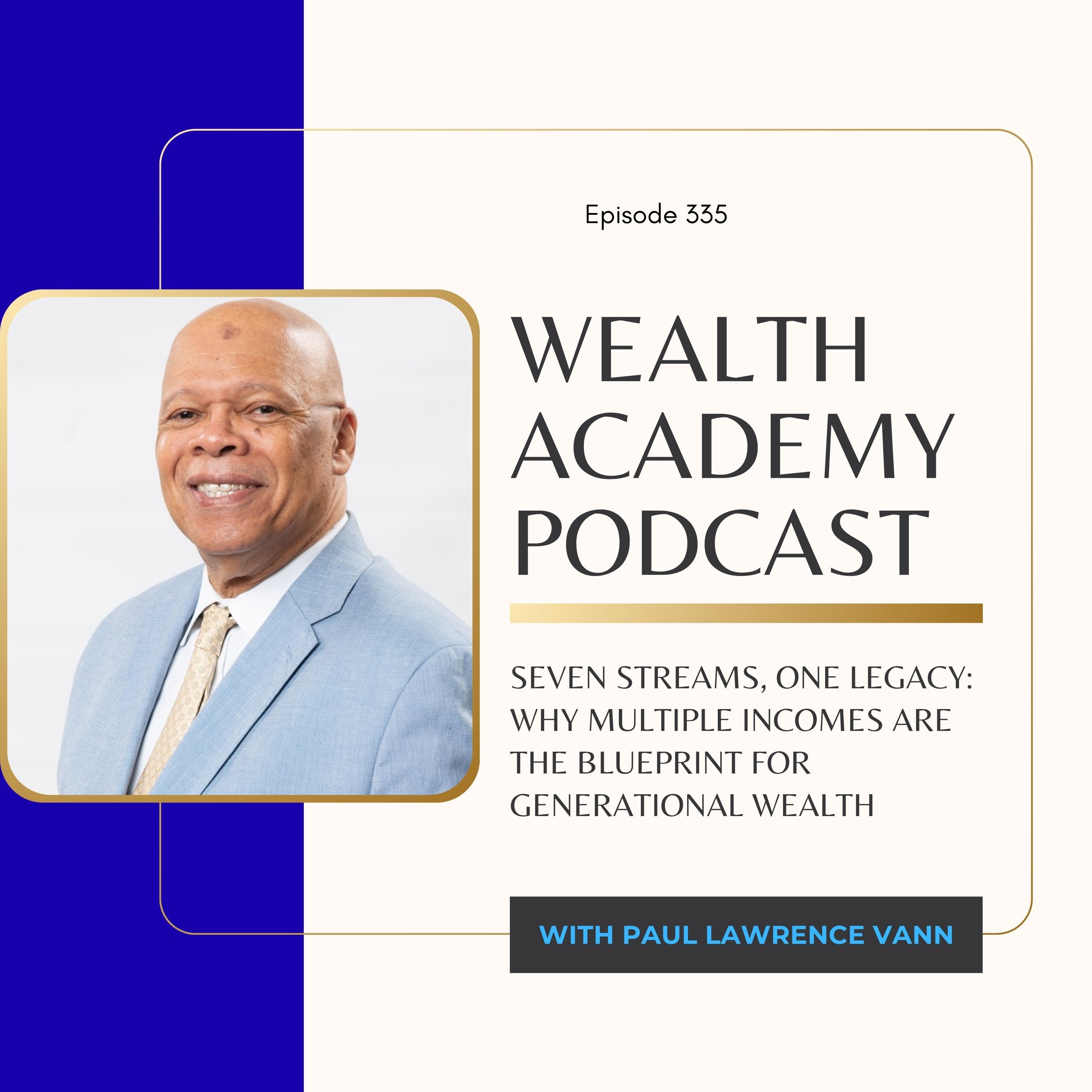
Episode 335: Seven Streams One Legacy: Why Multiple Incomes Are the Blueprint for Generational Wealth
The Story
In Episode 335 of the Wealth Academy Podcast, Paul Lawrence Vann delivers a powerful and strategic message about one of the most important principles in modern wealth building:
One stream of income creates survival.
Multiple streams create legacy.
In today’s economic climate, where layoffs, inflation, and market volatility are realities, relying on a single paycheck is no longer a wealth strategy. It’s a vulnerability.
In this episode, Paul breaks down why building multiple income streams is essential for financial stability, freedom, and generational wealth. He explains how earned income alone rarely produces long-term prosperity and how wealth builders intentionally create asset-based, leveraged, and ownership-driven income streams.
This is not about chasing side hustles randomly.
This is about building structured, intentional, income-producing systems that outlive you.
If you want to stop depending solely on employment and start building income that multiplies, compounds, and transfers to future generations — this episode provides the blueprint.
Because wealth is not what you earn.
It’s what you build.
It’s what you own.
It’s what you leave behind.
What You’ll Learn in This Episode:
• Why relying on one paycheck limits long-term wealth creation
• The difference between earned income and leveraged income
• How dividend stocks, real estate, and business ownership create sustainable cash flow
• Why asset ownership is critical for generational wealth
• How to identify additional income streams aligned with your skills
• The importance of consistency when building passive income
• Why lifestyle inflation can destroy wealth-building momentum
• How to create a five-year multiple income strategy
• The mindset shift required to move from employee thinking to ownership thinking
Speaker 1: Welcome to Wealth the Academy podcast. Thanks for tuning in to listen to this dynamic and insightful podcast with host Paul Lawrence Van. Paul and his guests provide content rich information that will enhance your knowledge. Enjoy this episode.
Speaker 2: Good day, good day everyone. On the host Paul Lawrence Van, and welcome to the Wealth Academy podcast where we teach you that wealth is more than just made. It is a leadership discipline by nature intelligence and legacy building strategy. During this episode, which is focused on the seven streams, one legacy, and live multi-game incomes, all the blueprint for generational wealth. I'm the host Paul on his van, the leadership catalyst. I'm a retired Air Force Lieutenant Colonel, certified financial manager in Arthur, the book.
Speaker 2: Leadership is influenced, which is an award-winning book. And I really look forward to sharing this information with you as a part of the February broadcast episodes. So again, this is episode 305.
Speaker 2: separates the financial stability from the financial unstoppable, the multiple streams of income. If 2020 taught us anything, the inflation taught us anything, it layoffs. Part us anything is this. One strain is vulnerability, multiple streams creates stability, and ownership creates legacy. So with that being said, welcome to today's episode, and I want to just lean into this particular topic because it's really one whereby you're not one-dimensional, but you're multi-dimensional in terms of your power, financial power.
Speaker 2: So if you're a primary income
Speaker 2: 60 days, six months, generational wealth is not built on a paycheck. It's built on assets, investments, intellectual property, businesses, dividends, real estate, strategic ownership, and it's important to understand this. A wealth builder is simply don't rely on one source of income. They build systems that
Speaker 2: So if the stock market is down, you still have your life insurance. If that's down, you have your real estate investments. So there are a lot of strategic ways to approach that seven figure streams of income. Today I'm going to walk you through eight critical questions to determine whether your building income or building legacy. And I think it's very important to understand the difference between that. dependent on one income source. Answer this question for yourself, just as I'm answering it. If 80 to 100% of your income comes from one employer, our client, you'll financially explode, spobes.
Speaker 2: Wealth builders reduce risk by diversifying income. So when one market is down another is up, and that maybe helps you maintain the balance. It's just like investment in the stock market, You may have monthly dividends that you receive from different companies, but you're also invest in growth companies. These are companies that have not haven't been around that long, but they have a really wonderful projection for success in the future. For example, the AI industry right now is really going through quite a revolution, quite a change in businesses have to adapt to it.
Speaker 2: And that's just one example.
Speaker 2: Again, wealth builders reduce risk by diversifying their income and it's very important because you have to have more than one source and able to to make it because if you have one source, let's say if you lose your job or you lose a contract, then you're going to really struggle for a while until you can regain that are regain more of it and then what assets are currently paying you, that's the question that you want to ask yourself. What assets are currently paying you? Salary is an active income.
Speaker 2: As to create assets income. Do you own dividend paying stocks? What about rental property? A business? What about royalties, digital products? So I can fill the line for each of this. I have a dividend paying stocks. I have rental property before. that I had people that actually paid for my house and then I sold it and I have currently have a business I get royalties from my books that I've written and then I have digital product. So if your money is not working, you are. In other words, if you don't go to work, you don't earn money unless you, of course, you don't leave or you have a vacation.
Speaker 2: So the thing that you want to really position yourself for is to understand that past. I need a side hustle. And as a result, that side hustle can also add to your income, and oftentimes it may be passive income, which is a great thing. I should not only have your active income to salary, that you receive in your benefits, but you also have something that's generated income, plathably, in addition to what you get each of every,
Speaker 2: Now, the next question is questions three, am I investing consistently? Are occasionally consistency bills, streams? In other words, the more you invest, the more you have the momentum to generate more income. So it's a good thing. Even if you're in a stock market and you lose a little bit of money, if the current price of the stock goes down, you still have other stocks that can offset it. And as for example, I just had a stock that my presentation and I purchased it at a high number at that time, it wasn't that high, but then the valiant stock dropped.
Speaker 2: And so what I did when it dropped, I just bought a couple more shares of it because in the end, I'm going to break even because that that stock is going to go back up and then you. so I'm not concerned with it. In fact, it happens to be the company that has generated the most revenue in the United States thus far. So that gives you an idea of what it is. And wealth is built through repetition, not randomness. In other words, you double down, like I doubled down on that stock purchase. And I bought purchase additional shares of it, because I know it's going to go back up because it's a very dynamic.
Speaker 2: And then let's say a few investing consistently, occasionally, let's say it used an example, $500 monthly invested into dividend producing assets over time. And that creates predictable cash flow. For example, that looked at a stock as a wheat and real estate investment trust. And they are good because they invest in apartment, apartment buildings, Of course, we know that as many houses are being purchased now, I've been built right now at the home building and the street is on the down turn because we lost a lot of, or he's as a result of people being deported, et cetera.
Speaker 2: And so rentals are, or if you have investment in stock with the malls, So you can invest in that and office buildings and most buildings are weeks, even some schools, colleges, a lot of them are weeks. And so that gives you even better example. And so what happened, I would calculate it, how many shares of stock, excuse me, I would have to purchase in order to obtain a yield of 1200.
Speaker 2: Well, $12,000 per year. And I calculated that particular number. So if I purchased X number stock in this week, then I know I would bring in an additional $12,000. And that just happens to be one stock that I'm invested in. But I'm in death sentence.
Speaker 2: And I know how to end up. So you want to allow your wealth and you want to build it through repetition, not randomness is very, very important to understand this. question for us, do I have a skill I can monetize outside my job now? We're talking sad about this now. You're still working for a time, many of you all, and if you are, that's great. That's that can supply. your source of income to help you start a business. But if you had a skill to monetize outside your job, how about public speaking?
Speaker 2: Public speaking is always a great, great feel. And you don't have to go to a location in person. You can actually do it digitally now, or virtually now, about consulting. Well, consulting is really great because you're taking the expertise that you have and you provide it to a company of organization coaching is another coaching doesn't have to be one on one coaching. It could be group coaching and it could be coaching for a entire company. What about writing? As I mentioned before, right now I'm writing my fourth book and so that again gives me that
Speaker 2: I can write the book one time and it can sell for years and years and then what about content creations and you want to look in a social media area? That's another great area and of course we know A.I. Literacy is one of the big ones. You can actually start an agency with that because a lot of companies, especially small business, they don't have people who are actually working in that field. So you're sitting on intellectual property and you have to protect it. In other words, if I write a book, I have to get the copyrights, and everything, a trademark, get everything in order.
Speaker 2: So that property isn't stolen. In fact, I had started my podcast, Well, the Academy of Podcast, which I'm on now, and someone came back and they named it very similar to mine. But the reason why I still have priority on it is because when you look at the year, I started it
Speaker 2: According to over 300 episodes where there is no denying that I started at the podcast before the other person, so I'm not worried about it. And then you have to monetize it. You have to set it up where people can pay you. You can have a funnel. You can put it on. You can also have a lead generation. You can get that from putting together a monthly newsletter and much, much more. So again, looking at it, do you have some skills that you demonetize outside of your job? Question number five is, is my lifestyle if expanding faster than my income street?
Speaker 2: Now, this one you have control over. And many professionals, they increase their lifestyle before increasing their streams. And this can be a very dangerous, in other words, if you're trying to keep up with the Jones is by an house and a gated community, a bond, Nice European import vehicle or you're just purchasing things. Are you going to cost his pen? $5,000 for a concert, which to me really makes no sense at all.
Speaker 1: But that's just me, I dig rest.
Speaker 2: And so you want to put yourself in a situation. You don't want to put yourself into a situation that creates pressure, not prosperity. Strings must grow before spending does. In other words, don't don't purchase something before you actually have the cash and hand because contracts can be canceled at any time. Opportunities can be also a council at any time. So you have to make sure you have the money in the bank and you can't mess around.
Speaker 2: want to move it into those fields that want to give you the best chance to generate some extra revenue. And so this also is very, very important. And the next question is, number six is, am I building income that survives me? So we're talking legacy, we're talking generational wealth. And generational wealth asks a bigger question, will this income continue
Speaker 2: And for an insurance policy, it definitely can't end. Same thing for you have books that can continue because the books will still get royalties that come through. And also the digital products. So that's why it's important to ensure your intellectual property because if you don't, people will try to get it from you. And they'll make money off of you. I noticed one thing that I was doing.
Speaker 2: I would put out a newsletter twice a week and then I I cut it back to once a week, but what I found is that other people in my industry, which is leadership and finances, they were actually taking a content that I developed and putting it on their newsletter. And I would make posts and they would have the same posts as mine. They would just change your name. So what I did is I stopped posting things. because I felt that they would have to learn how to do it themselves as opposed to really copying what I was putting out there on that atmosphere.
Speaker 2: And so that shut them down. But it's amazing that people who claim to be professional and have expertise, a lot of them don't have it, but they know you have it, and they were tried to, really undermine what you're doing and consider themselves an expert without even having the knowledge of what they're talking about. So that's kind of how that goes. So it and that came through observation. So let's look at this with the income continuing if I'm no longer here and I address that that it can be.
Speaker 2: are put your business into a trust. And investment accounts, dividend portfolios and business ownership, all of these things matter. And so I just really want to emphasize that these are some things that you can do to really make a tremendous difference. Now, questions seven, let's move on to that. And it's a question I post, you do. are do you understand the difference between earn income and leverage income? Earn income requires your time at the job, at the brick and mortar business, building for the company that you work for and with.
Speaker 2: And leverage income multiplies the time, wealth built a shift from trading time to building systems. In other words, if you have to be at a certain place, and that's the only way that you can earn money. in many ways you're very limited. But if you have other sources of income and you have a small business and you have someone who manages that business for you while you're in the job. For example, you could have government contracts and government contracts can, you don't necessarily have to be the one who delivers the product.
Speaker 2: You just have to make connections with people who are experts in that area who can deliver it for you. You pay them. You split the contract. and you both have a win-win situation. And so that's very important. And then you can leverage it by investing in, let's say, multi-family properties. So you invest in that. You would have revenue generated as a result of that. And then you may conclude this to the building. And that will also help increase your income as well.
Speaker 2: And the Everest income. And so, again, earned income requires time. You have to physically be at the facility working. You have to be there to ensure that you get the 40 hours a week, whatever it may be, you get paid. But the Everest income, it multiplies you times. And you can do more as a result of having an extra income stream there. And then question A to what is your five year multiple income strategy? Remember, no plan equals no strains. So you have to start thinking multi-dimensional in terms of generating that income.
Speaker 2: So do you, if you're in a stock market, do you have a dividend target? What are you trying to mean? That spoke earlier about a new of our purchase, Exynon Over the course of the year, you can receive $1,000 a month of dividend income. So that gives you 12,000 per year. And in other words, you're giving you money a job, and you don't necessarily have to be in a physical building in order to receive that money. You just simply keep your eye on the particular stocks that you're interested in, and that the money work for you.
Speaker 2: And then as a real estate acquisition plan, do you have a real estate acquisition plan, do you want to purchase a dueplex, do you want to purchase a multi-family property, do you want to invest our purchase office buildings? So these are things that you can do our now, a days you can invest in a range. And Reeds are required to divide 90% of all the income that they bring in with their shareholders. And it's written by law, so they only take 10%. But the 90% they have to give out because it's the people who have this shareholders who help build the company up.
Speaker 2: And then what about a business revenue go? You have a small business owner. Are you looking at bringing in a business plan? You want to put that, you can get grants for that as well. And then a digital product roadmap, you're going to have to go out there on Canvas, put together $27 product, and you're going to get up there and sell it to people. And then that leads to coaching and other things. So legacy is, in fact, intentional, and it's important to remember that. So here's what I want to share with you, The wealth legacy income framework, my five-string foundation model, number one is the primary income career, our business, number two is investment income dividends, ETFs, our REAPS, number three asset income from real estate equity ownership, number four intellectual property, income things such as books, courses and speaking, and then number five strategic side enterprise.
Speaker 2: Consulting coaching digital services. The goal is not to start all five at once. The goal is to start one more this year and then let it compound Then let compound growth multiply it and that's the essence of it, but again real quick primary income which can consist of either your career or business investment income dividends ETFs and REITs asset income real estate equity ownership intellectual property income books courses speaking strategic side enterprise consulting coaching digital services and the go is not to start all by that once the go is to start one more this year then let compound growth multiply it
Speaker 2: that a little bit of struggling going on to put it on how much income you earn and whether you have a how-in situation that allows you the opportunity to still have the income left over, your insurance, or car, if you have kids, and then multiple streams are designed for freedom. If you want generational wealth, you want options if you want to retire dignity, if you want your children to inherit assets instead of bills, You cannot rely on one income source. You must lead yourself into ownership.
Speaker 2: You must bill, access that produce cash flow, and you must think beyond your lifetime. Because wealth is not what you earn, is what you bill, is what you multiply, is what you transfer. And legacy does not happen by accident. It happens by strategy. And that's what I've been sharing Last two episodes with you on episode 3333 and 334. So here's the call to action. In this episode, challenge you. Here's your assignment. Number one, identify your current income streams, and write them down so you can see what it looks like.
Speaker 2: I wrote it down and it scared me. A loss of hair and I'm ball headed. Number two is choose one additional stream. to begin building within the next 90 days. Number three, increase your financial literacy around dividends, real estate, our digital ownership, and number four, share this episode with someone who needs to stop relying on one paycheck. And if you're serious about building multiple streams and creating generational wealth, join the wealth building academy community. Go out there and visit us at www.pawvancespeech.com.
Speaker 2: in a role in the next financial mastery session. Because here's the truth. You don't build generational wealth with one stream. You build a with strategy, discipline, and ownership. This is Paul Lines van, the leadership catalyst, and I'll see you on episode 336. And one of the things I always share is that to go out there on Apple Podcasts
Speaker 2: and the generous with a five-star review out there on Apple Podcasts and ensure that this content that you share with others, you share it with members of your family, you share it with your colleagues, and with your friends. And that will really be a wonderful thing for you to do. So everybody is learning and they're growing in the process.
Speaker 2: It was my pleasure to work with you through this today because this is a very important topic and again, the question that I posed to you is to help you because we talk about seven strains, one legacy and why multiple incomes are the blueprint for generational wealth. So my time is up and I thank you for yours. Again, the name is Paul Lawrence Van. And I really appreciate you for being here life in addition to on the archive. Have a good day, and I'll see you on episode number 336. Have a great day.
Speaker 1: Thank you for listening to this episode with Paul and his guest. I hope you enjoyed this episode, and Paul requests that you write and review this episode and others on Apple Podcasts, and wherever you listen to podcasts. View all wealth Academy podcast episodes at www.wealthacademypodcast.com.
 Apple Podcasts
 Castbox
 Castro
 Goodpods
 Moon FM
 Overcast
 Pocket Casts
 Podbean
 Podcast Addict
 Podcast Republic
 Spotify