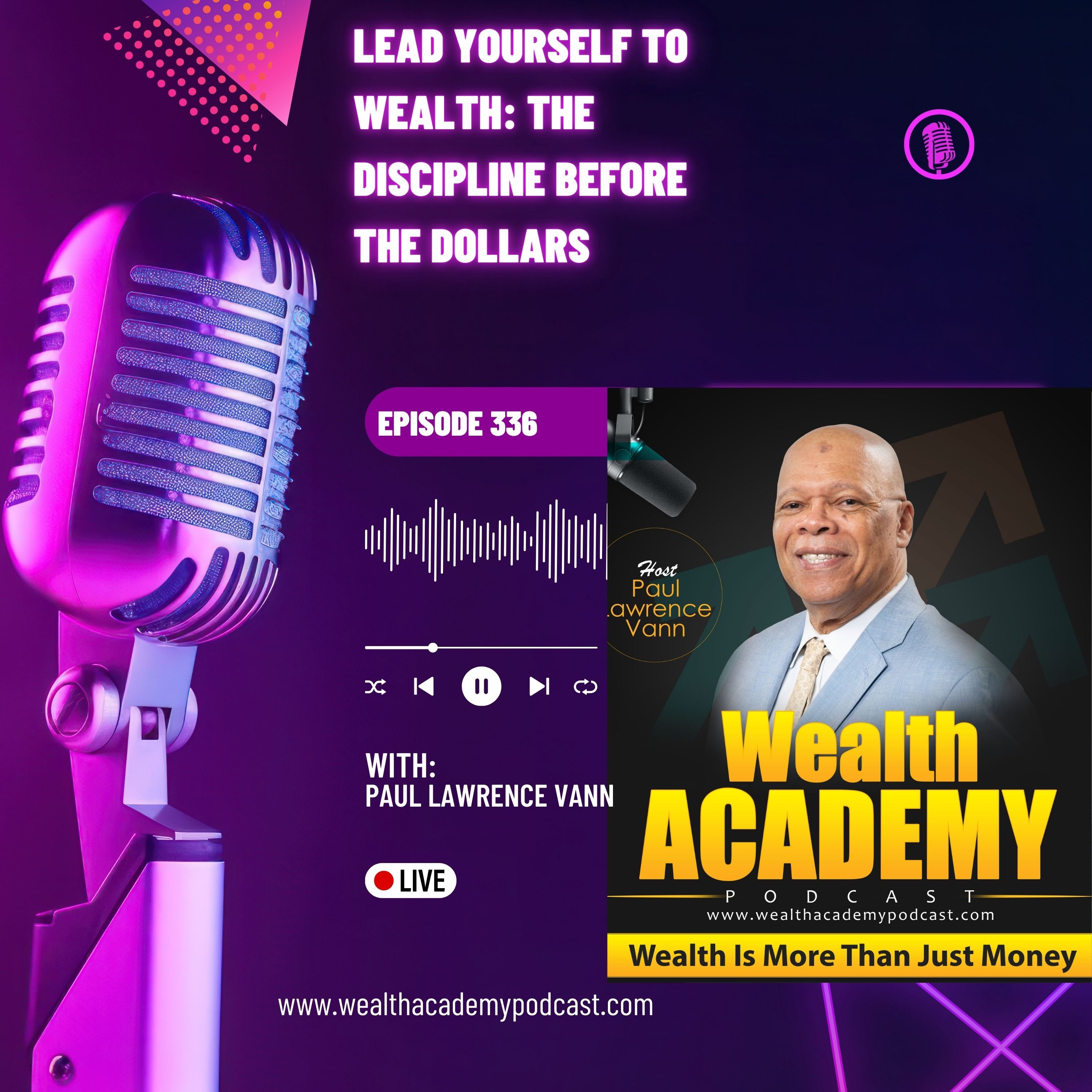
Episode 336 - Lead Yourself to Wealth: The Discipline Before the Dollars
The Story
In Episode 336 of the Wealth Academy Podcast, Paul Lawrence Vann delivers one of the most important wealth-building truths you will ever hear:
Your wealth strategy will never outperform your self-leadership.
Before you grow your portfolio…
Before you build multiple streams of income…
Before you achieve financial freedom…
You must learn to lead yourself.
In this powerful episode, Paul explains why discipline, emotional control, clarity of vision, and daily financial habits matter more than market timing, stock tips, or side hustles. Wealth is not first a money issue, it is a leadership issue.
If you’ve ever struggled with consistency in saving, investing, or following through on financial goals, this episode will challenge you to examine the root cause, your personal leadership capacity.
This is not about motivation.
This is about mastery.
Because wealth doesn’t respond to hype — it responds to disciplined behavior repeated over time.
Why You Should Listen to This Episode
• To understand why self-leadership is the foundation of financial success
• To learn how emotional discipline impacts investment decisions
• To discover how daily habits determine long-term wealth outcomes
• To identify the behaviors that sabotage financial growth
• To develop clarity around your written wealth vision
• To strengthen your financial consistency during market uncertainty
• To shift from reactive money management to intentional wealth strategy
• To build a leadership-based approach to generational wealth
• To stop drifting financially and start leading your financial future
Speaker 1: Welcome to Wealth the Academy podcast. Thanks for tuning in to listen to this dynamic and insightful podcast with host Paul Lawrence Van. Paul and his guests provide content rich information that will enhance your knowledge. Enjoy this episode.
Speaker 2: day to everyone. I'm your host Paul Lawrence Dan and this is episode 336 and I want to focus in on those areas to lead yourself to wealth, the discipline before the dollars. So one has to take place before the other. and it's just great to be with you today. So welcome to the Welp Academy podcast where we teach you that wealth is more than just money and I really like to reiterate that and I'll define it right now as that of course having resources such as money is great but you also want to have good health, mind, body, spirit, relationships, you want to be able to have some empathy for others and as well, and self leadership happens to be one of those aspects as well.
Speaker 2: So it's also about the mindset, leadership, discipline and legacy. So again, I'm your host Paul Lawrence van. I've started this podcast in 2020 and I'm up to episode 336 and counting. I'm known as the leadership catalyst. I'm a retired Air Force Lieutenant Colonel and certified financial manager and Arthur the book, leadership is influenced, which is an award-winning book and I'm thankful for it. And also, I want to delve into the leadership excellence because without leadership is very difficult to get things done, not only in your personal life, but in your business life as well.
Speaker 2: And today we're talking about something most people skip over in their pursuit of financial freedom. They look for strategies, they look for stock tips, they look for side hustles, and they look for short cuts. But they ignore the foundation. And again, as I mentioned before, the foundation truly is self-leadership. And what is self-leadership is having that ability to lead yourself, your self-awareness, your self accountability, responsibility, communications, empathy, and much, much more. And these things
Speaker 2: and you generating wealth and not only for today but generally as well. So you must build your discipline within yourself. So let me say something bold to you here right now. Your wealth strategy will never outperform yourself leadership capacity. Now I want to read this again because I really want you to get the emphasis of what I'm saying. And it's this, your well-strategy would never outperform your self-leadership capability, so that the self-leadership comes before your strategy. Now, if you like discipline, you will sabotage good investments.
Speaker 2: by purchasing things that you want as opposed to purchasing things that you need and taking it from not only self gratification now, immediate gratification as opposed to to
Speaker 2: delayed satisfaction for the long run, and so that point needs to be made as well. So it's with you like clarity, you will also drift financially. And if you like consistently, you would never benefit from compounding because compound interest For example, if a person is 20 years old, they start working in all the 10 college, by the end of the 20 years, if they have invested wisely with clarity and with discipline and consistency, they will possibly become a millionaire. It just all comes down to how they view their money mindset and their relationship with money.
Speaker 2: Now, wealth-building is not complicated. but it is and must be consistent. You have to consistently pursue a wealth, it give you a money, a job, because your money wants you to give it a job, and it needs you to give it a job, because it wants to grow. It's just like planting a flower plant, or a tree. Over time, it grows, it develops, and then it matures, and that's the same thing with money. And consistency is truly a leadership decision. You have to decide whether you want to pursue this and you pursue it with passion and addition to purpose.
Speaker 2: And leading yourself to wealth means delaying gratification as I mentioned before, managing your emotions. You see that nice, shiny car, it looks great, look great and it drives way and the garage at your house. and you want it, but you're going to have to fight those emotions off and go with a hoopty if you have to. And I hope that it's just a car you just want to get by for now because you know in your future you have a luxury vehicle because you've already paid the price for it. And investing regularly has to be on your list of things to do and increase in your skills,
Speaker 2: And being willing to learn more and more, for example, I recently signed up for a stock investing course. And I'm telling you, I grew and leaps and bounds. I took several courses. I took a pass and income course. I took a debt pay off course. Then I took a stocks 101 and a stocks 102 course. and addition to some other courses that are part of the program that I joined. And it really opened me up to see, wow! not thinking about what if I had a 20 years ago, it has nothing to do with it, it has to do with the now, right now and moving forward.
Speaker 2: And I see myself really achieving a lot in that investing space for sure. And then again, you want to invest regularly and increase your skills and live below your means. This does not mean you're in ramen every night. but what it means is that you don't eat out every night and the money that you would have spent by on all the coffee each day, you would take that investment stock, invest in some real estate, invest in insurance policy and doing different things that will grow and you don't have to actually
Speaker 2: Position it so it can reinvest and set or receive and dividends monthly. You just reinvest it back into that stock where you can buy additional shares. And that's how you do it. And then with real estate, you fix up the property and then increase the value. You can ask for more rent and art if you decide to sell it. So there are many ways of doing it. And then thinking long term. Now, this really walks right into that aspect of vision. What is your vision for your money in the future? And your money wants you to give it a sign, Matt, and you don't want to disappoint money, right?
Speaker 2: So this, of course, is not glamorous, but it is very powerful and today I'm going to give you eight self leadership questions that determine whether you are truly leading yourself to work well or just wishing for it and wishing just like hope is not a strategy you have to actually take action come up with a plan, take action and then remain consistent.
Speaker 2: do you have a written wealth vision? So I'm going to ask myself that as well so that you can get the just of how this particular episode is going to go. Do I have a written wealth vision? If it's not written, it's not strategic. That's just the bottom line. You have to write down so you can watch it and see it every day and see if you stick into it. It's almost like a vision boy. on steroids. And that's what you want to do. You want to write it down and leave in yourself to wealth requires clarity.
Speaker 2: In other words, net worth goes. So what is your net worth? Your net worth is the number of assets you had. and you subtract your expenses from it, or your debt against that, and that gives you your net worth as of today. No matter where you are, whether you're just starting out as an employee, or if you're starting out as an entrepreneur, or as you're working for an organization, you want to have some net worth goals, and that investment target. So, do you want to buy a
Speaker 2: Doplex, you live in one side, and you have someone listening it from you on the other side, that's actually a pain for the entire dueplex itself. I do want to go with multi-family properties. So those are just some examples of some things that you may do of consideration too. And then what about debt elimination plan now? As I mentioned before, I just enrolled in a completed debt payback plan. And what happened within 30 days, a paid off probably $13,000 worth of debt on personal loans as a pertain to my business and for credit card debt.
Speaker 2: So 13,000 and 30 days in this month, I'll probably do the same. And a lot of it just has to do with leveraging the money that I have, but I have written out a debt elimination plan as a part of the program that I happen to be in. and I can target the high interest rates and go with a debt avalanche approach or I can go with this snowball approach, the lowest debt that I have, pay that off and then go to the next lowest debt and pay that off. But I've been doing a combination of both I've been paying it off.
Speaker 2: avalanche perspective and it's no ball perspective and these are some strategies that people use to help them to take their debt down and of course I always like to keep my credit score as high as I can. I had reached 800 and I wanted to get to 850 which is the maximum so I'm still working to get to that point as well as a part of my goals and then what about retirement I want to give you some insight into myself and that I retire from the Air Force as a lieutenant colonel at the age of 43. So I had worked 22 years and now I've been retired for 24 years.
Speaker 2: I've been retired and yet I still worked because I started wealth done in academy LLC as an entrepreneur. It was a logical transition for me because I've been working since the age of 10
Speaker 2: And as a result, business and finances is always been a part of who I am. So it's easy for me to fit right into that glove, the hand in the glove, and the clarity of course creates accountability. And so it's very important to know that. So again, with this particular question, do you have a red and wealth vision? And if you don't, you may want to start considering one and it would be very positive for you to do that. And limit question two, are you emotionally disciplined with money? So again, I ask myself this, am I emotionally disciplined with money?
Speaker 2: My answer to this is yes and it is because I'm still standing. Over the course of my life, I've owned two houses, a so-one, and then I've had several vehicles, whole life insurance policies, term life insurance, now the stock market, and just rolling along. And so when it comes to that, that does not come, having these things, does not come
Speaker 2: Well, I looked at my brokerage account, and when you see red, it means that the value, the cost basis, which is how much you've invested versus the market value, is how you determine whether or not the stock is in the red or positive. And the red may only mean that the amount
Speaker 2: invested was $100, and now it's reflecting $98, so the red would just be about $2. So it's not that bad, and you have to weather the storm, of course, and a lot of it is moved by, for example, to state of the Union address last night, that impacts it. and companies coming in and they're talking about capital expenditure which means people land in billions of dollars to align themselves properly with artificial intelligence which also has an impact on the minimum employees you're going to have or you're going to let go and different things such as that and does stress cost spending.
Speaker 2: In other words some people they have with what they call going to the mall. And so they're going out, it's going to make them feel better about purchasing things. Well, that's going to work against your dead paydown. But that's what some people go through in terms of retail therapy is the word that I was searching for. And so you want to make sure that you don't find yourself that stress causes spending. And does comparison cause over spending. So this is keeping up with the Joneses, if you will, they are living in a gated community so surely I must live in one as well, which when you read the book, the neighbor next door, is the exact opposite, people who blue collar work as plumbers and people who work electricians, that type line of work, which is great work, they tend to live within that means a lot more than someone who has a bougie title, you know, I'm the doctor of so and so and so and so and so and as a result, the so and so and so is paying off a lot of student loan deaths to try to keep up with their contemporaries.
Speaker 2: their peers and their colleagues and they find themselves and I hold out a debt starting with the B-word bankruptcy. So we want to be careful trying to keep up with everybody else, but stay in your lane, be happy, be comfortable with yourself, and because you are not better than anyone, but you're just as good, which is one of my favorite quotes. So leadership over money begins with leadership over emotions. You have to really keep yourself grounded. and there's nothing wrong with making purchases but do comparison shopping.
Speaker 2: You don't have to have a new shiny car coming off the lot. It has that new car smell, but get one that may have 10 to 20,000 miles on it. The same vehicle has just been one owner before you. So looking at things that way to take the emotion out of it, be level headed with what you do because if you're not, it's a lot worse. It's a lot better to be level headed than to be over-heat in debt. It just doesn't work. So we've covered two questions so far, do I have a written wealth vision, and I want you to start in right one.
Speaker 2: And then the second one is MIT, mostly discipline with money, the emotional aspect. So let's go to question three, do I consistently invest regardless of market conditions? And we all know each and every day the market shifts. Not only in the stock market, but real estate with the interest rates, with a blind apartment complexes or office buildings, it all adjusts, but wealth builders don't wait for perfect timing. They practice discipline timing and compounding rewards consistency. So we have to not look at it as an overnight success.
Speaker 2: in terms of you want that money now, you know, somebody younger people they go into shady businesses as a result of, they just want that money now. They're not even thinking about tomorrow. And that can land you in the polky, as we say. So you want to be disciplined, and you want to be consistent in your investing approach. And I look at over the course of my career multi-billiness of dollars for the United States Air Force and my capacity in acquisitions as well as working on capital Hill with members of Congress to get more for the military services.
Speaker 2: And as a result, I built up this level of discipline. And just like I'm taking down my debt once I become debt-free, it's okay for me to go in debt for investment properties and stock and insurance policies because it will compound over time. So we're going to go to question the fore now and my increase in my financial this is the key to it all because the more you know the better you can do. So in other words, you want to read some books that talked about financial intelligence. you want to listen to other people, some of your contemporaries who are at that level that you're at because you can't talk to everybody.
Speaker 2: Sometimes you can't talk to family members. The conversations is just above them. And it's not that they're bad people they can't learn is that they're just not into it. So you have to move beyond that and work with some people who are into that. And that's why I just recently joined the the passive income community in terms of looking at the future. And then studying when I'm going through those courses that they provide, I have a head down and I'm a learning as much as I possibly can. And then you want to analyze things.
Speaker 2: So for example, I invest in a stock market after go and study of those investments that I made and watch television,
Speaker 2: And then I've learned how to select a particular stock, you know, what are my goals for this is the monthly dividend or is it quarterly dividend or is it for growth stocks, which is you in it for the long run, the growth stock could very easily be a Walmart. It could be an Amazon, it could be a target company looking at that to analyze that. And you cannot grow what you do not understand. In other words, I don't select stock blindly. I base it on the analysis that I've learned and how to compare different stocks or if I'm purchasing it.
Speaker 2: I've been a real estate investment for and I lies in the property. And getting into property for no money. and getting it as is perspective and taking over the long, that way you don't even have to go to the bank. So there are different ways of doing it. So again, you want to ask yourself that question, and I increase in my financial intelligence. that they more you know, the better decisions you can make. And so that's the key to that. So let's go to question five. Do my daily habits, align with my long term goals, and what this entails is daily spending, reflects your leadership.
Speaker 2: So if you find yourself at the casino every day, and I have a casino that's a five-minute drive from my house, then I don't go there too to gamble. I go there most of just to kind of see the new site's decorations they have and I may eat at one of the restaurants occasionally, but I'm not the type of person who will go into a casino and just roll the dice and put it all on the line. I've been to Casinos before and once I spend $15 if I don't win, the big win, I'm out. But most people can't walk away from that, but I can't because it doesn't interest me that much.
Speaker 2: And so you want to make sure that you can handle it. That has an emotional aspect to it as well. So that daily spending reflects leadership. And then daily saving reflects leadership and not that saving is going to really improve your retirement years, but the saving is the position you as for a resource to put into the stock market or into a life insurance policy or any other investment instrument that you happen to be considering. And daily learning reflects that leadership Because once when you study every day, for example, I have this book about this wonderful author and this person, if you can see this book here, and I'm reading her book is pretty bad, pretty thick, but she has some wonderful insights into finances, financial literacy, and taking it to the next level.
Speaker 2: And again, it's called Get Good With Money. You say so you have to learn as you go because if you tell me that you know it all there's nothing more you can learn then at that point I know that you're in trouble.
Speaker 2: I've never forget the first time I had my first book, titled, Living On High Ground, had a book signing at Joint Base Bowling, which is five and then five miles from where I live. And this gentleman was a retiree, a military veteran, and he looked at the book, he's a congratulations, but I don't need to read anymore books. There's nothing more for me to learn. And I looked at him like, you're in trouble. Because we can always learn something to the last breath that we take. And so I just looked at that and said, well, I know I'm not going to be like that.
Speaker 2: So your habits evoke for your future. In other words, when we look at, spending, how reflects leadership, daily spending, daily saving, and daily learning, reflects leadership as habits that we're talking about. And our habits and your habits vote for your future. So it's very important to understand that as well. So let's go on to a question six, who holds me accountable? And so I ask myself that, Do I hold myself accountable? And every leader needs accountability. Again, it's part of that self-leadership and ban that self-awareness.
Speaker 2: The more you know about yourself, the more you know the decisions that you've got to make especially when it's undergone, it's under pressure. And you have to make a big decision to see me. I have been served 20 years in the United States Air Force's military officer. I know how to make decisions. I make them quick and I don't look bad. Most people don't understand my decision, but I do. And so I don't worry about what people think, because it's my life. And as a result, that's how I look at it.
Speaker 2: So every leader needs that accountability. And are you in community? Did you track your net worth? Do you review your investments quarterly? I'm guilty, I review mine every day. And I'm glad that I do. Now, leadership without accountability leads to drift. And what I mean by this is that you take start taking things from granted. and you never want to take things for granted, especially yourself. And so when it comes down to investing of any accounting, you want to, that's even your time that you have.
Speaker 2: You want to make it count. And as a result, leadership without accountability, they can at least to drift for you. See the next shiny object, and you lose your train of thought if you will, and you are not taking responsibility, so an essence you're holding yourself accountable. A question seven reads this follows, do I respond to setbacks with strategy or emotion? Because we know that markets fluctuate, and they're supposed to, jobs change, and they do. Expenses arise and it's going to happen every day of your life somewhere and it's self-leaders, leaders, adjusts and they do not abandon the mission.
Speaker 2: In other words, you keep what's important, the main thing, the main thing. and things that don't matter, don't matter. If you keep that particular philosophy, you will go a long way. And so when you respond to setbacks with strategy or emotion, again, you want to maintain and even kill the invest your money. Of course, we know that there's no guarantees that you've been always have a positive on your investment, even with a house. When we look back at the impact that COVID had, we look back at the financial.
Speaker 2: They, the global financial crisis we had in 2007, 2008, and that time frame, we know that things can change. And we've adjusted to it and we've done a really great job. And so we want to keep it that way. But do not abandon the mission. You do not want to abandon the mission. And let's get down to question eight. Am I building wealth for freedom or for image? I'm not doing mine for image. Some pursue wealth to impress. That's not my daily way. Because again, it's your life. It's not someone else's life.
Speaker 2: Others pursue wealth to impact. Well, the impact is to lead that legacy in generational wealth. That's really what impact is. But true leaders are built through wealth
Speaker 2: have an options in life, security, as well as legacy, and intent determines the endurance. In other words, you consistently invest, invest, invest, keep your eyes on the prize, of looking and reading material that gives you even more insight into a particular investment, knowing that there are people about a standing behind you that will be impacted if you were to depart in transition into the spiritual realm. Again, when we look at well for freedom or image, true wealth bill is again, and I'm going to repeat this focus on having that freedom.
Speaker 2: to be able to make the decisions they want to when they want to, have an options whether or not locked in because they have more than one stream of income. And recently, I would discuss having seven streams of income on the previous podcast episode, podcast episode 335. And that opens the door for you to understand that if you have multiple streams of income, one will offset the other. In other words, if one area is not strong, then you have another one
Speaker 2: and so you want to have those options and then for security that you do in fact have that insurance insurance policy that will help you in the case that something happens to you and then of course legacy. not thinking only of yourself, but getting a trust in place, I prefer a trust over a will because with a trust, you can protect your assets, so it is asset protection, as well as you, whereas you won't end up in probate court, and that's my goal in life. So again, intent determines endurance. And we'll get into the clothes now, but I want to share the four pillars of lead in yourself to wealth, and it includes pillar one, which is the vision.
Speaker 2: Know where you're going. I have a that vision. And then pillar number two is discipline, control your behavior consistently. And then pillar three is education grow your financial literacy. And then number four, this execution, take action repeatedly and consistently. And when these four lines, wealth becomes a predictable outcome, not a possibility, because you're predicting your success in the future through what you do now, so it doesn't the odds do not work against you, they actually work in your favor.
Speaker 2: So let me leave you with this wealth does not begin in your bank account, it begins in your behavior. It begins in the decision to say when other spend investment others hesitate, steady when other scroll and plan when others drift. Now I want to go back real quickly to invest when others hesitate. Meaning that's safe to roll a stock market goes down. A particular stock is timed by.
Speaker 2: Don't let it get high and then by you let that start this fall as low as you can go and buy that because over time it's going to come back high again. So I want to make sure you understand that and plan when others drift and steady when others grow. I'll lead in yourself to wealth is not about being perfect. It is about being intentional. You cannot delegate your financial future and you must lead it. In other words, you can get a broker advisor, but there's no one that is more responsible for your money than you are.
Speaker 2: a broker would take your money, and they'll put it in this, that it's not going to impact them. It's going to impact you, so you have to know more than they do. That's why I took this investment course, because if someone is, I can, I go to someone and if I decide to let them take over my broker's account then, um, based on decisions to conversation we have, I would know whether or not they know what they're doing. And that's why you have to study. So again, you cannot delegate to your financial future.
Speaker 2: You have to lead it. And when you lead yourself consistently, money begins to follow discipline, and, as, again, is consistency. So, here's my call to action for you. I always have a call to action because I really want you to understand better what to do. First of all, write down your three-year wealth target two day. Write it down. If it happens to be night, write it tonight. but a three-year wealth target. Identify one habit that is misaligned with your financial vision and eliminate it. For example, procrastinating about making a decision to invest, are money that you should be investing, you're buying shiny objects, stuff that you want, based rather than stuff that you need.
Speaker 2: And then you want to increase your automatic investment contribution by at least 1%. So if you are investing at the company, you work with what company, and they have a shareholding, then you want to increase that by 1% because they were likely match what you're investing yourself. So if you invest $50, they'll give you 50 as well. And that's a great way to build up wealth. And then share this episode with someone who needs to stop drifting financially. And if you are serious about transforming from a consumer, to wealth builder, join the wealth builder and academy community.
Speaker 2: Also visit me at www.PaulVanSpeaks.com and enroll in our next financial mastery session. Because here's the truth, you don't stumble into wealth, you lead yourself to it. This is Paul Lawrence Van Deletiship, Katlus, and of course I look forward to seeing you on future episodes as well. So my time is up and I thank you for yours. I'm glad that you're here with me right now, on episode number 336 and it is an honor to always be able to share with you. And again, when we look at all of these dynamics that are taking place in the world today, episode 336 is lead yourself to wealth, the discipline before the dollars.
Speaker 2: It's a very, very powerful testimony to those of us who are keeping out as on the prize and that prize is to ultimately have that financial freedom that wealth. And again, my time is up and I thank you for yours, my name is Paul Lines van. Thank you so much for being on this episode with me. and refer to your friends, your family, as well as your colleagues. And go out to Apple Podcasts and provide us with the five-star review and we appreciate you more than you would ever know. Have a great day, everyone, and I'll see you on episode 337.
Speaker 2: Have a great day.
Speaker 1: Thank you for listening to this episode with Paul and his guest. I hope you enjoyed this episode and Paul requests that you write and review this episode and others on Apple Podcasts and wherever you listen to podcasts. View all wealth Academy podcast episodes at www.wealthacademypodcast.com
 Apple Podcasts
 Castbox
 Castro
 Goodpods
 Moon FM
 Overcast
 Pocket Casts
 Podbean
 Podcast Addict
 Podcast Republic
 Spotify